Transhuman, all too Transhuman

Two books published in the Colin Wilson Studies series are very contemporary – yet the contents are four decades old.
As a reader of Wilson since the last century, reading a ‘new’ book by him is an unusual experience now. Despite knowing that his uncollected or unpublished work is a rich seam, it’s an odd feeling to know that this is all posthumous; that there’s not going to be two or more new books a year and that one might be blessed with the inevitable cut ‘n paste review containing all the old annoying cliches. This stuff, published by Paupers’ Press, is made and consumed (mostly) by hardcore readers and collectors.
In a strange sense though, it’s like the spotlight is off Colin Wilson, the person, and firmly on his ideas. (Unless you’re an obituary writer). These two books are full of ideas, despite their brevity.
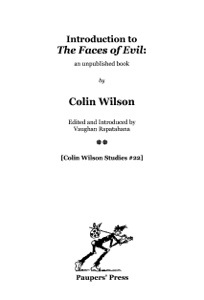
Colin Wilson Studies # 21 contains two essays from 1974 or thereabouts: Comments on Boredom and Evolutionary Humanism and the New Psychology. Studies # 22 is a previously unpublished Introduction to a book which would have been called Faces of Evil, if it ever appeared. Possibly from the mid to late Seventies, the only trace left of its existence is a cover image, advertising blurb and ISBN number: 0-89104-042-0. It was to have featured 60 full colour illustrations and 30 original paintings in it’s 128 pages.
Edited and introduced by Wilson scholar Vaughan Rapatahana, these essays “make sure you cogitate and they force you to ponder further.” A well known effect for Wilson readers. Another plus is that the topics he writes about here are very relevant – a point not lost on the editor.

Boredom. (Trans)Humanism. Evil.

Humanism, as it’s understood – or should that be marketed? – today is a different beast to the Humanism that Wilson writes about here. ‘Humanism’, with it’s corporate logo, London bus adverts, celebrity atheists and it’s general sense of bourgeois self-satisfaction is not really the Humanism that Wilson is writing about. That sort of Commercial Evangelical Humanism has more in common with the creature comforts of der letzte Mensch, Nietzsche’s ‘last man”, the opposite of the bed of nails that is (will be?) Das Übermensch. Wilson’s Evolutionary Humanism has more in common with Julian Huxley’s original concept as discussed in Beyond the Outsider. Huxley, in fact described himself as a “Transhumanist” – a point we’ll need to return to. So even though he can write that “My religion is evolutionary humanism” (1) he is not advocating a simple replacement of Theology with Darwinism, as that would be too philosophically crude. Rather, he is attempting to describe, with as much phenomenological precision as possible, the access code to a “new world of super-reality and anti-futility.” (2) H G Wells’ metaphor of early amphibians struggling to stand or breathe on land is referenced, but Wilson suggests that the need to flop back into the cool waters of “repetitive little preoccupations and animal responses” is best described in the opening scenes of Goethe’s Faust, in Nietzsche’s Zarathustra (3) and in Dostoyevsky’s figure of Stavrogin. These three are expositions of what Wilson calls “the values problem”, the problem of life fatigue and life failure. Our instinctive values or rather, subconscious intentionalities, have been built up over millions of years, and they need to be analysed for deep, deep prejudices in the light of everyday consciousness. Because our habit of selective consciousness is so ingrained – originally for our survival – it continuously replaces any sense of wider meaning with a sense of immediate purpose, with the ability to concentrate on getting things done, but generating unpleasant side effects of neurosis and social friction.
Wilson sees the imagination as part of perception. Imagination moulds the perceptions of the physical world, although “it has a tough sub-structure of reality to deal with. However, it colours and shapes and tints and excludes, and the resulting perception is not in any sense a perception of ‘things as they are’. It is carefully edited.” (4) This is the instinctive value mentioned earlier; in fact it is actually a “devaluing mechanism.’ Things can be perfect in life, and we take them for granted – in fact we are normally bored (this is discussed more fully in the Comments on Boredom essay). What is happening, says Wilson, is that we instinctively put aside the pleasure and move on to the next thing. “This means that, from the feeling point of view, consciousness is kept blank – that is, open and receptive. But if there happen to be no ‘in-coming’ feelings, the result is boredom.” (5) The chief value (ironically) of the devaluing mechanism is pain and inconvenience – we can get over minor physical pain or setbacks by devaluing them and moving into something else. Wilson calls this the ‘St. Neots Margin’, a kind of equator of the human mind that is affected by pain, but indifferent to pleasure. We take happiness for granted, but only start to ask questions when we suffer misfortune.
Now Wilson introduces an important concept. As our consciousness is editing our environment, certain things are left on the cutting room floor. The full beam of our intentionality is focussing on a limited number of things, whilst others are noticed, but in a less immediate way. They are out-takes, like the extras on a Directors’ Cut DVD that we will probably never watch. They are there, they are important, but taken for granted – like, Wilson remarks, a pair of guests who are so familiar to the butler that he doesn’t need to ask for their invitation card. They are accepted – but rather than call this process ‘acceptance’, Wilson describes this mechanical observation as ‘acceptation’. For convenience, acceptation “is the actual medium for the dilution of consciousness.” (6) it is, he says, like ash which prevents the consciousness from overheating. The inferno of total consciousness would generate too much heat for us at this moment, so we use our powers of abstraction and imagination to bring back enough for a camp fire. We supplement our awareness with memory and imagination.
The imagination should not be confused with daydreaming. “It is related to ordinary perception as as mathematics is related to science; it is concerned with the basic laws of the reality that perception can only grasp piecemeal.” (7) Perception is intentional, it is selective – and it is prejudiced. A strongly developed imagination can easily be used to remind ourselves of how our selective consciousness has become what it is, and why.
Wilson is keen to remind us that we are marking time with our present consciousness. We cannot go any further with these old habits, the door of the prison is opening, but far too slowly, and while we’re in this state, “we need war as a necessary outlet.” (8) Bearing in mind that these words were written forty years ago, little has changed. The problem is still staring us in the face, and people seem keen to avoid addressing it. Perhaps because, as Wilson says, we treat consciousness as a basic unit, rather than showing (or rather knowing) how it is built. Wilson once remarked that the problem of philosophy is so simple that no philosopher has ever stated it. He is on to something there.
Wilson’s Evolutionary Humanism is unlike today’s Humanism. Like Huxley’s Transhumanism, like Maslow’s self-actualising Metahuman, it is Nietzsche rather than Darwin who is the focus. So it is interesting to see the editor compare Wilson to Ray Brassier in The Faces of Evil. For although Brassier is a supporter of Transhumanism, he insists, somewhat theatrically, that we must choose Darwin over Husserl lest we “plunge headlong into intellectual disaster and the ruin of philosophy.” Brassier was once linked to the Speculative Realists, who claim originality for their use of H. P. Lovecraft in philosophical – specifically phenomenological – disciplines. They are still shamefully unaware of Wilson’s historical record here. Brassier, like Thomas Ligotti, like Houellebecq and S. T. Joshi, seem to admire Lovecraft for his fundamentalist nihilism. This is perhaps a little too convenient; Lovecraft’s nihilism is really his least interesting feature. It is a mask, the opposite of his real drive. (8) So although Wilson sounds like Brassier – or rather, vice versa – when he writes of Evil as “a vital force so tremendous that the slightest glimpse of it reveals our human values to be childish and trivial”, he is probably speaking Nietzscheian, or perhaps Blakeian (the antediluvians who are our energies etc.) rather than materialist nihilism. Lovecraft made the phenomenological mistake of describing his Things as “evil”, when they are in fact fascinating. Wilson offers Arthur Machen’s description of a similar experience, but minus any dread. (9) Perhaps Machen was a greater phenomenologist than his literary offspring…
So in these essays, forty years old, Colin Wilson is pretty much discussing today’s cultural impasse. Or maybe it’s just that not much has changed? The points he makes on these topics are certainly worth everyone’s attention.

(1) Colin Wilson, Comments on Boredom and Evolutionary Humanism and the New Psychology: two unpublished essays Paupers’ Press, 2013, p. 35
(2) ibid. p. 36
(3) Specifically the section entitled On the Tree on the Mountain (Nietzsche, Thus Spoke Zarathustra, Cambridge University Press, 2006, p.29)
(4) Colin Wilson, Comments on Boredom and Evolutionary Humanism and the New Psychology: two unpublished essays Paupers’ Press, 2013, p. 42
(5) ibid. p. 43
(6) ibid. p. 44
(7) ibid. p. 45
(8) Kenneth Grant The Ninth Arch, p xxix Starfire 2002
(9) see Wilson’s introduction to The Necronomicon (Neville Spearman, 1978)

Fortean Times CW obituary… with help from VIZ Comic

The latest issue of Fortean Times (FT310) has an excellent and lengthy (two full pages) obit by Gary Lachman which puts most of the attempts in the nationals to shame. Reading Wilson, Lachman concludes, “makes our inner gears a little bit stronger.” The letters page has a brilliant cartoon of CW from VIZ cartoonist Davey Jones who says that “I’m not the only person whose teenage ennui was eased by reading The Mind Parasites.”
Gossip also tells me that none other than Dame Edna Everage herself – well, Barry Humphries, anyway – is an admirer of Wilson. Perhaps we should guessed from this Edna quote – “There is, perhaps, no more dangerous man in the world than the man with the sensibilities of an artist but without creative talent. With luck such men make wonderful theatrical impresarios and interior decorators, or else they become mass murderers or critics.”

Existential Literary Criticism – CW Studies # 23

The work goes on.

Colin Wilson’s
Existential Literary Criticism:
a guide for students
by
Colin Stanley

For nearly sixty years, throughout his career, Colin Wilson has championed existential criticism, asserting that a book should not just be judged by the tenets of literary criticism or theory alone but also on what it has to say, in particular about the meaning and purpose of existence.
​In this study, a companion to his students’ guides to Colin Wilson’s ‘Outsider Cycle’ (Paupers’ Press, 2009) and ‘Occult Trilogy’ (Axis Mundi, 2013), Colin Stanley provides assessments of nine of his subject’s essential book-length studies on existential criticism and bibliographical details for the hundreds of essays and reviews he has written during the course of his long career.
​Appended to this is Wilson’s groundbreaking essay ‘Existential Criticism’ first published in The Chicago Review in 1959.
Due January 6th, 2014
201 pages. Paperback. £12.95.
I.S.B.N. 9780956866349
(Colin Wilson Studies #23)

Pre-publication offer: £11.95 (including postage/packing to UK addresses and delivery before Christmas)
Pay by PayPal to: stan2727uk@aol.com
or cheque, payable to Colin Stanley, from:
Paupers’ Press, 37 Quayside Close, Trent Bridge, Nottingham NG2 3BP.

Footnote: After generally disappointing run of the mill obituaries, Colin Stanley has written a rather more considered tribute. These two assertions stand out –
Those critics who have failed to see and appreciate [Wilson’s] talent are invariably those who have been intimidated by such a vast body of work and unable to distinguish between his ephemeral and essential books.
And –
When all is said and done, it is in [the] field of Consciousness Studies, that his true legacy lies.

Colin Henry Wilson 26 June 1931 – 5 December 2013.

By Vaughan Rapatahana

Given that Colin was himself rather prone to sweeping generalizations, indeed could on occasion be accused of hyperbolic rushes, I do not think that it is an exaggeration for me to state quite simply that Wilson was one of the more important writers and thinkers of his generation and as such that he will remain of considerable significance for many generations to come. Surely his huge oeuvre will be of even more exponentially increasing import as time headlongs itself forward, as readers and critics increasingly untrove the massive arsenal that is his written work, from libraries, second-hand bookstores and on the web.

The key to this rather prolix statement above is that Wilson was both a very good writer and a very good thinker – two polar opposites for the vast majority of writers and thinkers per se, who did not have his bicameral gift. In other words, not only could he write clearly, cogently and enthusiastically about a wide vista of – to him, always interrelated topics – but he would write about them existentially, always existentially, for everything he wrote, down to his lesser fictive excursions and his rants on subjects such as gardening – always had some ontological and epistemological grounding in this, his overall Existentialist Weltanshauung.

It is this, his quasi-obsession drive to relate everything to and from his own profound inner nuclear warhead, his mystic overview of how things ‘really should be’, that impelled him to write, transcribe, read, rave and produce prodigiously for a healthy number of years and indeed for well into two distinct centuries.

This impellation was, of course, to translate and codify his prime philosophic truth: that man is greater than he/she thinks he/she is and that – damn it – he/she bloody well should be doing something about evolving a lot faster, transmogrifying into the true mighty Being they inherently all are.

It is this, Colin Wilson’s DNA of preaching and teaching our evolution into something natural yet supernatural, for which we will remember him, I think and not at all for the rampant bullshit written about him, nor for any foibles that he may or may not have had as a man, as an author.

In the end then, as I write a tribute according to the parameters of Wilson’s very own Existential Literary Criticism, I can unhesitatingly say that he is a taonga (as we Māori say) – a veritable vibrant treasure to be shared for years and years to come.

CW obituary – from The Independent (and many others)

Writer and philosopher whose work, beginning with ‘The Outsider’, searched for the meaning of man’s existence
Colin Wilson was one of the most prolific and eclectic writers of the 20th century. In more than 150 books and countless articles and contributions to other works, published over 50 years, he covered subjects as diverse as existentialism, esotericism and the occult, religion, biography and several volumes of autobiography. It is his groundbreaking work on existentialism and creative thinking, The Outsider, published to wide critical acclaim in 1956, that remains his best known work.
Wilson was born in Leicester in 1931, the son of a shoemaker. He left school aged 16 and over the next eight years took on a variety of unskilled jobs while writing. “I kept a voluminous journal, which was several million words long by the time I was 24,” he recalled. Since the age of 12 he had been preoccupied with asking the meaning of human existence and at 14 had read George Bernard Shaw’s Man and Superman, from which he realised that “I was not the first human being to ask the question.”
Living rough on Hampstead Heath, working at a café and spending his days at the Reading Room of the British Museum, he had been trying to write a novel when the outline of The Outsider came to him. Photographs from the time show the handsome bohemian figure sitting alone, leant against a tree, wrapped in a sleeping bag and with a book in hand.
Inspired by the title and content of Camus’ novel l’Etranger (The Outsider, 1942), he sought to rationalise the psychological dislocation associated with Western creative thinking. Wilson took the outline and sample pages to the publisher Victor Gollancz, who immediately accepted the book. Published on 26 May 1956, The Outsider sold out of its initial print run of 5,000 copies in one day.
Cyril Connolly said it was “one of the most remarkable first books I have read for a long time” while Philip Toynbee called it “a real contribution to our understanding of our deepest predicament”. It shows how artists and writers such as Van Gogh, Kafka and Hemingway are affected by society and how they in turn, as “outsiders”, impact on society. John Osborne’s Look Back in Anger had just opened at the Royal Court and the term “Angry Young Men”, invented by JB Priestley, was first used in the New Statesman the following week and stuck. Although Wilson said it was not a group with which he identified, his later work The Angry Years (2007), recalls the period and the characters of Osborne, Kingsley Amis and others.
The Outsider made Wilson £20,000 (equivalent to £430,000 today) in its first year. He said later that he had not been surprised by the positive reaction but had not anticipated what followed – “the tremendous backlash, and the attacks on me which I found pretty hard going.” Referring to Religion and the Rebel (1957), his novel Ritual in the Dark (1959) and other works over the coming decade, he noted, “I’d produce some book which I knew to be brilliant and I’d get lousy reviews.” Evidently, the literary Establishment was not pleased at an uneducated, working class writer getting so much attention and praise, despite their initial enthusiasm. With media attention now focused on Wilson’s domestic affairs, his publisher suggested he leave London for Cornwall, where he remained for the rest of his life.
Wilson’s book The Strength to Dream (1962), a study of imagination in literature, had a title he later said he should have used for his autobiography, based on a phrase by George Bernard Shaw: “Every dream can become a reality in the womb of time for those who have the strength to dream.” Wilson was one who had that strength to dream and to see his dreams become reality in print.
In his Introduction to the New Existentialism (1966), Wilson revisited the themes of The Outsider, suggesting that the “old” existentialism “was a philosophy of man without an organised religion… Man stood alone.” He believed the challenge the “new existentialism” has to face is this: “Can it again point to a clear, open road along which thought can advance with the optimism of the early romantics?” He goes on to demonstrate that it indeed can. Elsewhere he speaks of those “curious moments of inner freedom” or (in his memoir Voyage to a Beginning) “visionary intensity”, which hint at a purpose in an otherwise meaningless world.
Towards the end of the 1960s an American publisher commissioned Wilson to write a book on the occult. This took him in a new direction, towards the realms of the esoteric and alternative history, at a time of considerable interest in New Age subjects. The Occult: A History (1971), revived Wilson’s critical reputation. “The reviews had a serious and respectful tone that I hadn’t heard since The Outsider,” he wrote. “With a kind of dazed incredulity, I realised that I’d finally become an establishment figure.” He developed an interest in crime, particularly the psychology of murder; his later works continued in the dual veins of existentialism and mysticism, but all touching in some way on what he called the “curious power of the mind that we hardly understand”.

Wilson had suffered a stroke in June 2012 and was no longer able to speak. He died in hospital with his wife Joy and daughter Sally at his side.

Colin Henry Wilson, philosopher and writer: born Leicester 26 June 1931; married firstly Betty Troop (one son), secondly Joy Stewart (two sons, one daughter); died St Austell, Cornwall 5 December 2013.

(Obituary written by Marcus Williamson).

The few other newspaper obits that have appeared aren’t as knowledgable as the above, sadly. It’s all about knowing your place and not getting too clever.
The Times actually expect money for this scissors and paste atrocity. Read it here for nothing, as that’s all it’s worth. (Thanks to Colin S. and Frank).
The Torygraph (didn’t they know CW edited the Thatcher-friendly Marx Refuted?) has this rather more generous attempt.

20131209-031747.jpg
Another from The Guardian. Apparently written by someone who died in 2010! Fortean Times have been informed of this remarkable achievement.

NY Times piece by Margalit Fox. CW scholar Brad Spurgeon “contributed reporting” it notes.

Nice personal piece by CW scholar Gary Lachman

Philosophy Now piece by poet Vaughan Rapatahana. Great stuff – [Wilson’s] “‘New Existentialism’ remains a lodestone in an increasingly bleak world peopled by the Dauphins of fundamentalist religions and the fundamentally anti-fundamentalist acolytes of Dawkins.”

This is an excellent appraisal of CW, concentrating on The Occult and it’s central thesis.

Here’s an interesting piece at The Daily Grail by David Metcalfe.

Local obituary from This is Cornwall.

And another from the other end of England

BBC piece. I do like this sentence, describing the post-Outsider Cycle era – “In later years, however, he confounded critics with a prolific output in dozens of unconnected genres”.

An ill-timed attempt at humour backfired at The Indy, causing it’s author a little concern. Here is a refutation of most of the points made.
A letter appeared in The Independent on the 15th of December –

This writer was no ‘silly myth’

“Don’t create silly myths about yourself,” writes Terence Blacker of Colin Wilson (“Eternal Outsider”, 10 December). He declares himself unimpressed by the photograph of the writer with “swotty polo-neck and specs” which appeared on the back cover of Wilson’s book The Outsider.

Yet the “silly myth” of a provincial taking a sleeping bag to Hampstead Heath and reading Kafka and Nietzsche in the reading room of the British Museum proved to be an inspirational one. The nobody from nowhere who had attended a technical school showed he had something original to say, and – even to this day – many members of the Oxbridge-educated literary establishment have never forgiven him for that.

Ivor Morgan, Lincoln

.

20131210-000749.jpg

This blog page has the interesting end comment that “if his greatest achievement was to reveal the fallibility of the critical establishment, that was something worth doing, even if not what he intended”.

This obit argues that CW’s autodidactic nature is relevant in our Information Age.

X marks the treasure. A Colin Wilson appreciation

He changed my life. No irony, he really did. And I’d like to show my gratitude.
When I read that Colin Wilson told Iris Murdoch that he wanted to live until he was 300, I seriously imagined that he would. Every year, a CW book or two (or more) would appear without fail, usually in the same minimalist paperback cover from Grafton. There was also his vast back catalogue to find. Far too much for my teenage purse to obtain, yet I found it all, eventually. There was also an impossible yet complete necessity to read everything he discussed – yes, all of it, because everything he described sounded completely amazing. I’m still working in that one. Now it feels very strange to know that the only writings I’ll be reading by him will be posthumous. The obvious fact that a serious illness left him unable to write for the past year has still not prepared me for this feeling. Neither has the appearance of several “lost” essays and articles, some decades old, instead of any brand new CW product.
Not only is it hard to comprehend to that Colin isn’t with us any more, it’s disappointing to me that I’ll never know his opinion on say, a contemporary criminal case, no longer wonder at some obscure theory or author he’s distributing.
Without Wilson’s conversational discussions of literary theory, I’d otherwise have been seriously intimidated tackling the modernist heavyweights such as Ulysses, In Search of Lost Time and The Man without Qualities; yet he made these – and many others – accessible and exciting. To make Husserl’s Phenomenology and the Crisis of the European Sciences equally accessible is an even more striking achievement. And the list of my discoveries via Wilson goes on and on, from the ivory tower to the gutter. That for me was one of his best aspects originally, enabling complete access to recondite knowledge. In pre-internet days this was very liberating for a council estate kid such as myself. Class, of course, was perhaps one reason why Wilson wasn’t appreciated by academia during his life; who needs a middleman when you can have easy access to the source, from one plain speaking autodidact to another? Another extraordinary aspect was his tone. It was as direct and enthralling as the Rock n’ Roll I loved, and as intrinsically meaningful as the ‘high culture’ which I was told I couldn’t understand. With a pellucid prose style ringing out as loud as Faust’s Easter bells – it was never “prairie flat”- narrating life affirming patter like a phenomenological cab driver, well, this obliterated my adolescent angst and confusion. And not a moment too soon. Without his honest guidance I’d be much less happy and intellectually frustrated. And I’m very satisfied that I made the difficult journey to Gorran Haven to tell him this. Not once, but twice. I wish there had been more.
So far, so good. Just the above reasons would be enough for me to celebrate CW. But twenty five years later, I’m still finding amazing angles in his work that escaped me the first few times around.
Philip K. Dick, by his own admission, a “fictionalising philosopher” rather than a mere SF hack, was critically ignored for most of his life. Scratching out a meagre existence, like Lovecraft before him, by writing pulp for pennies. Yet PKD’s ‘pre-cog’ oeuvre so accurately describes the world we live in now, you could call it a documentary. Several decades too early, but still uncannily accurate. His time has come, however belatedly. Colin once said with regard to the perception of his own work that “the times are out of joint”- quoting The Bard (and unconsciously paraphrasing PKD himself). This is true, but Wilson never really worked in that much of vacuum despite the ups and downs of the mainstream critical response (mostly in his homeland). He has a large fanbase and a cottage industry devoted to analysing his work and keeping obscurities in print. That alone is enough to keep his work alive and there’s no doubt that this will slowly pave the way for Wilson to eventually be fully analysed by academia in the coming century.; it’s inevitable as academia (in the humanities) do not generate their own content. Will they be able resist (from a safe posthumous distance) a huge and controversial body of work which anticipated several genres (true crime and Lovecraft as philosophy for two) with so many tendrils of the Wilson narrative entwined with post war and late twentieth century culture? I doubt it. But this isn’t really what Wilson’s life-work was about. His work was about each of us developing own own intentional consciousness, understanding the creativity of consciousness far away from the pessimism and relativism if his era. For his astounding impact on my education and his deep influence on my own civscuousbess, I’m forever grateful. Thank you Colin Wilson.

Faces of Evil: CW Study # 22

A previously unpublished essay by Colin Wilson is released on October 14th, at £8.95 (£7.95 for pre-orders, including free post within the UK). Order direct from Paupers’ Press.

20130919-100704.jpg

Colin Wilson’s
Introduction to The Faces of Evil

Edited and with a Foreword by
Vaughan Rapatahana

In the mid-1970s A & W Publishers of New York planned to publish a book by Colin Wilson entitled The Faces of Evil. The publisher’s blurb read:

​“One of Britain’s foremost authors re-examines man’s ​haunting fear of evil, in mythology and history. Witches, the ​supernatural—Hitler, Stalin, Rasputin, and Richard the Third are ​re-appraised in an informative, fast-moving essay strikingly ​illustrated with historical reproductions and 30 original paintings.”

The book did not appear in print and all that remains is the substantial Introduction—over 80 pages in manuscript—written by Wilson and recently retrieved from an archive by Wilson scholar Vaughan Rapatahana.

In a stimulating essay, Wilson concludes:

​“I would not like to pass a dogmatic opinion on whether there are ​such things as evil ‘entities’ in the universe….That would ​presuppose that they are living beings who, like ourselves, are ​struggling to evolve to a higher level. But it seems to me wholly ​within the bounds of possibility that human beings have released ​‘evil’ forces of whose power and persistence they are unaware…”

Colin Wilson Studies # 22
ISBN: 978-0-956866332

Paul Newman – a personal memory

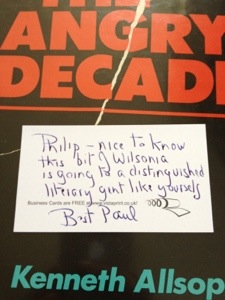
I’m very sad to report that Paul Newman, editor of Abraxas magazine, amongst other talents, passed away recently. I was aware of Paul’s struggle with illness several years ago. I finally got to meet him at the Around the Outsider launch after years of amusing off-on correspondence via Abraxas. In my nascent days of Wilson fandom he was an invaluable link to the man himself, providing signed books* hot from Tetherdown, and up the minute information before the web took over. An extremely pleasant and knowledgeable man, Paul wrote several books, and I would recommend his autobiography, which turned out to be his final published work.

* Via the Abraxas book signing service, which I became aware of through the back page of CW’s Ouspensky biography in 1993, I managed to get Colin to sign my copy of Voyage to a Beginning as “Lord Leicester” – a disguised self portrait from The Mind Parasites. Neither Paul or Colin himself got the reference and thought I was merely being inventive!

20130629-104953.jpg