
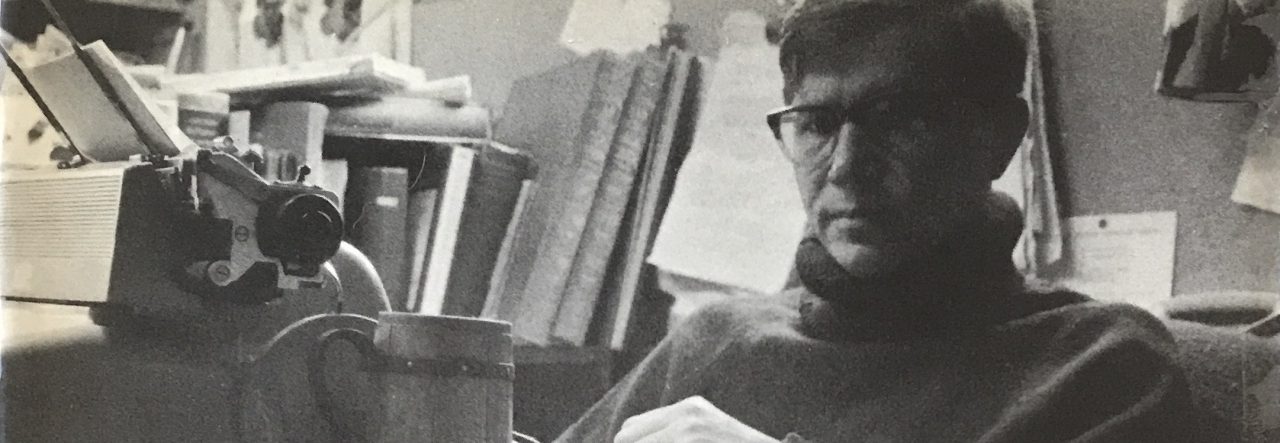
A new book of essays recently celebrated 70 years of Colin Wilson’s debut – it is available here [Colin Wilson Studies # 37]. I don’t yet have a copy of this but as a show of support here are some of my own thoughts on The Outsider.
The Outsider is three score and ten this year, a Biblical lifetime. Most amazingly, it is still in print; not bad for a book about the vagaries of consciousness by an unknown working class youth (would this kind of thing happen now? Of course not). In the public imagination Colin Wilson’s name will be for ever and always linked with this one book and its rather scandalous success which was followed by a critical turnaround and berating by the Establishment. But truth be told it’s not even his best book – it is after all only the first part of seven (the ‘Outsider Cycle’ ran from 1956 to 1966). While a close reading of The Outsider shows it contains many of his later concepts in embryonic form (for instance, the development of “a certain faculty” which “increases […] the sense of other times and other places”), a useful solution toward the problem of everyday life-failure that the book addresses would only become apparent as the series reached its conclusion. (The mysterious faculty he refers to would be thoroughly examined a little later in Wilson’s next bestseller, a wonderfully entertaining ramble through ‘occultism’ in 1971).
“I wrote The Outsider to try to express what is wrong with us” remarked Wilson in a 2005 interview with Philosophy Now. And what is wrong with us? Our consciousness, which is forever selecting and cutting out wider meanings. For Wilson, this quirk of human perception is paradoxically responsible for both our swift evolutionary progress and for all the whining nihilism that contradicts it. He explains that the average person, “looking at himself from what Husserl called ‘the natural standpoint‘, doesn’t feel there is anything much wrong with him. But some men develop a curious inner dissatisfaction, which may amount to a vague feeling of ‘Who am I?’” This, Wilson explains, is implicit “in the ultimate ‘existential’ question” and may lead to “the possibility that ‘I’ may turn out to far more than I had assumed”. It is this “curious inner dissatisfaction” that is the concern of The Outsider rather a study in mere social awkwardness (which Wilson describes in the book as an Outsider’s “obvious abnormality, his introversion”). Another layer of the book argues that ‘Outsiders’ need to stop being ‘outside’, socially, and play their necessary role in civilisation, but this is secondary to the individual psychological analysis; the former concern is examined in the second and third volumes of the series and more thoroughly in his later books, such as New Pathways in Psychology and Order of Assassins.
Wilson examines his Outsiders through biography and quotations from various writers, poets and thinkers to illustrate an active or ‘lived philosophy’. For this he has been criticised, in his defence he has pointed to Ernst Cassirer and Karl Jaspers, both of whom used this method without harming their philosophical credentials. But no matter, for the keen reader Wilson’s argument is clearly expressed throughout the book. An ‘Outsider’ has a strange, rather distressing and uncertain sense of “unreality” about everyday reality, a permanently nagging dissatisfaction with the poker faced grain of the world, ‘reality’ as seen through Husserl’s ‘natural standpoint’, the viewpoint of the “normal individual” or “naive man” as Husserl had it in 1900.
The argument of The Outsider is not far from Husserl’s own, except Wilson was not aware of his philosophy until a few years later. He admitted that his discovery of the philosopher didn’t really make much of a general difference to his efforts as he’d been concerned with transforming everyday consciousness into something more meaningful since childhood. He also observed that Husserl’s ideas had already been anticipated by Blake and Nietzsche, two classic ‘Outsiders’. However, Wilson’s investigations into the genesis, development and practicalities of Husserl’s phenomenology gifted him a rigorously workable method to help solve these ‘Outsider’ problems, just as his acquaintance with Prof. Maslow’s self-actualising humanistic psychology or Sperry and Ornstein’s split-brain theory, to name only a few, would later.
At the end of the eighth chapter Wilson comments that an Outsider believes that he – or she [1] – can establish a permanent way of seeing into themselves and solving these problems. ‘But how?” he asks. “By establishing a discipline to overcome his weakness and self-division”. Most people are – as he would explain in the third volume of the ‘Outsider’ series – what sociologists label ‘outer-directed’: “put them on a desert island with nothing to occupy their minds and they would go insane”. Conversely, and with some amount of terminological irony, ‘Outsiders’ are ‘inner directed’. In The Outsider Wilson continues by quoting Kierkegaard’s famous existential parable of bored Gods creating bored humans, but he remarks that although this is indeed a penetrating commentary it isn’t a particularly useful observation. Truth be told Wilson always thought Blake more original than Kierkegaard, and his life and ideas more dynamic. “Blake’s solution was: Go and develop the visionary faculty. Good. But how?”
The philosopher John Shand has quoted another philosopher, Prof. Stephen Clarke: “Wilson does have some interesting ideas about attention, inattention and boredom. Indeed I don’t know any other philosopher who has had more to say about that very philosophical disease.” This disease or perceptual vicious circle is well summarised in a line from Ezra Pound’s Canto XV: “inchoate error, boredom born out of boredom” (it’s no coincidence that Pound is here railing against the “british weeklies” that would praise, damn and ignore Wilson later). Shand explains that the “key to Wilson’s thought is that we are led to nihilism by a fundamental philosophical mistake. That mistake is not to examine our minds, consciousness, first before we judge what the world is like”. When asked by The Times, again in 2005, what advice he would like to pass on, he answered “never give up. It cannot be said too often”. The suicides, tragedies and mental collapses documented and examined in The Outsider illustrate why developing this mental tenacity is important. Shand comments that “Wilson’s life indicates what can be done through taking one’s consciousness in-hand and through self-discipline refuse to sink into torpid despair at the vicissitudes of life. [He] has worked for fifty years without the handy financial and ego-enhancing props of regular academia, and survived the turbulence and vagaries of fashion”. Shand also admires Wilson’s formidable drive, “getting up every day at six and writing daily for hours productively in most literary genres”, noting how intertwined his philosophy is with his life. “‘You want to know about my ideas and I’ll tell you about my life,’ he says”. Wilson was as much of an Outsider as anyone he wrote about.
“The Outsider’s first business is self-knowledge” explains Wilson early in his book. However, this is not merely a literary pursuit: “the point I wish to make here is the fact that the ‘way’ [i.e. ‘the method’] is not a matter for words, but a matter for action”. This self-knowledge “must be lived”. An Outsider needs to “find a course of action in which he is most himself” and “change only his relation to his ‘inner-self’”, or “true ‘I’”, the latter term being an interesting one, as it was used by Husserl twenty years before in his final book. Significantly, Husserl also explains there that his phenomenological philosophy can offer “a completely different sort of waking life” consisting of a transformation of consciousness “which breaks through the normality of straightforward living”. This was also the claim of another Outsider, Gurdjieff. Similarly Wilson points out that once ‘outsider-consciousness’ begins to ferment “the world can never afterwards be quite the same straightforward place”. And indeed, it isn’t.
Wilson’s book is full of extraordinary people doing unusual and occasionally absurd things, but he does not regard these as mere eccentricities: “of course, people who are incorrigible self-dramatisers, like the young Nietzsche, are only trying to get themselves ‘outside’ the situation, and see themselves in the situation objectively”. A perfect illustration of the first discipline in Husserl’s phenomenology, the famous epoché or ‘standing outside’, then. As noted earlier Wilson rejected the common interpretation of an ‘Outsider’ as a mere misfit and the notion of this problem being only a social one is questioned in the first sentence of the book (“At first sight…”). This becomes more apparent as the ‘Outsider’ series progresses. “As a social type, the ‘outsider’ may be vague; as a description of a state of consciousness definable by phenomenology, it is precise” [Beyond The Outsider, p. 163]. This subtle distinction is so often misunderstood that I have to repeat it: ‘Outsiders’ – or ‘outsiders’ by 1965 – wish to get themselves outside their everyday situation, to see it objectively. This is the intent of whatever “course of action” they choose to live out, be it Blake etching his Illuminated Books through the night, Nietzsche dropping out of academia to seclude himself in cheap rented rooms or the famous Lawrence of Arabia deciding to become ‘John Hume Ross’ for a few weeks.
Twenty years after his first book was published Wilson recognised what, despite the furore, it was all really about: it was “the realisation that I had at last settled down to the serious business of living”. Looking back even further, in 2001, he cheerfully admits that his outlook is “now more pragmatically optimistic” than it was in 1956. The “serious business of living” is the living philosophy (the ‘new existentialism’) sketched out in The Outsider, developed through the series that followed and examined thoroughly in his best later works, non-fiction and fiction. “The philosopher starts from the sense that there is a lot of illusion about the world, and that his task is to probe to the reality” wrote Wilson in an essay about Tolkien. Existential and phenomenological philosophy are of course intertwined with the ‘reality’ that we face everyday, and the latter, in particular, offers pragmatic solutions on how we can change it, at least – at first – on an individual level. Wilson’s ‘new existentialism’ offers a coherent living philosophy for the ordinary reader, and the book of that name (1966) features disciplines and exercises based on the phenomenological method which can be utilised by “anyone who goes to enough trouble”. [2] Therefore, is it “not illogical to suppose” asks Wilson in The Outsider “that a development of the same faculty [of selecting, i.e. Husserl’s epoché] might lead the practical-minded European to see things where he saw nothing before”? Even though he clearly analysed it in two etched pamphlets on religion circa 1788, Blake seemed to posses this faculty instinctively, but as far as Wilson was concerned it was essential that some of us develop it in the daylight of ordinary consciousness. “It is necessary for at least a few men to develop a new type of consciousness, to develop it slowly, painfully, instinctively” he writes near the end of the book. “Would not such a man be a complete Outsider?”
[1] See Outline of the Female Outsider, volume one in the ‘Abraxas Collectors Series’, St. Austell, 1994. Some female Outsiders: Emily Brontë, George Sand, Mary Wollstonecraft, Marie Bashkirtsheff, Dora Carrington, Isadora Duncan, Virginia Woolf, Phillipa Burrell… This would have been a very interesting second volume complementary to The Outsider, had it been completed (circa 1991).
[2] In fact, this is a line from the previous (sixth) volume of the series, Beyond The Outsider (Arthur Barker, 1965, p. 82) explaining Husserl’s epoché. The slightly withering tone of ‘go on then, do it yourself’ never fails to amuse me.


Thanks so much Philip. Always enjoy your reflections on Wilson.
LikeLike
Thanks for your interest and kind comment!
LikeLike
I just published a piece on the indifference threshold https://themanoffire.substack.com/p/the-indifference-threshold if you’re interested.
LikeLiked by 1 person
Fascinating stuff, thanks! There isn’t really much writing about this particular Wilson concept, which is a shame as it’s an important one.
LikeLike