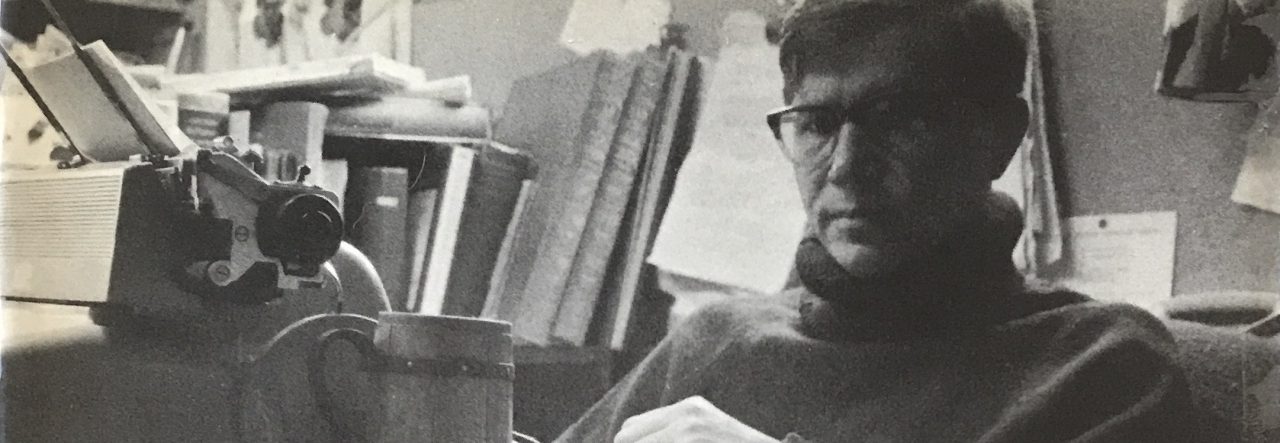
Seventy years of The Outsider

A new book of essays recently celebrated 70 years of Colin Wilson’s debut – it is available here [Colin Wilson Studies # 37]. I don’t yet have a copy of this but as a show of support here are some of my own thoughts on The Outsider

The Outsider is three score and ten this year, a Biblical lifetime. Most amazingly, it is still in print; not bad for a book about the vagaries of consciousness by an unknown working class youth (would this kind of thing happen now? Of course not). In the public imagination Colin Wilson’s name will be for ever and always linked with this one book and its rather scandalous success which was followed by a critical turnaround and berating by the Establishment. But truth be told it’s not even his best book – it is after all only the first part of seven (the ‘Outsider Cycle’ ran from 1956 to 1966). While a close reading of The Outsider shows it contains many of his later concepts in embryonic form (for instance, the development of “a certain faculty” which “increases […] the sense of other times and other places”), a useful solution toward the problem of everyday life-failure that the book addresses would only become apparent as the series reached its conclusion. (The mysterious faculty he refers to would be thoroughly examined a little later in Wilson’s next bestseller, a wonderfully entertaining ramble through ‘occultism’ in 1971). 

“I wrote The Outsider to try to express what is wrong with us” remarked Wilson in a 2005 interview with Philosophy Now. And what is wrong with us? Our consciousness, which is forever selecting and cutting out wider meanings. For Wilson, this quirk of human perception is paradoxically responsible for both our swift evolutionary progress and for all the whining nihilism that contradicts it. He explains that the average person, “looking at himself from what Husserl called ‘the natural standpoint‘, doesn’t feel there is anything much wrong with him. But some men develop a curious inner dissatisfaction, which may amount to a vague feeling of ‘Who am I?’” This, Wilson explains, is implicit “in the ultimate ‘existential’ question” and may lead to “the possibility that ‘I’ may turn out to far more than I had assumed”. It is this “curious inner dissatisfaction” that is the concern of The Outsider rather a study in mere social awkwardness (which Wilson describes in the book as an Outsider’s “obvious abnormality, his introversion”). Another layer of the book argues that ‘Outsiders’ need to stop being ‘outside’, socially, and play their necessary role in civilisation, but this is secondary to the individual psychological analysis; the former concern is examined in the second and third volumes of the series and more thoroughly in his later books, such as New Pathways in Psychology and Order of Assassins.  

Wilson examines his Outsiders through biography and quotations from various writers, poets and thinkers to illustrate an active or ‘lived philosophy’. For this he has been criticised, in his defence he has pointed to Ernst Cassirer and Karl Jaspers, both of whom used this method without harming their philosophical credentials. But no matter, for the keen reader Wilson’s argument is clearly expressed throughout the book. An ‘Outsider’ has a strange, rather distressing and uncertain sense of “unreality” about everyday reality, a permanently nagging dissatisfaction with the poker faced grain of the world, ‘reality’ as seen through Husserl’s ‘natural standpoint’, the viewpoint of the “normal individual” or “naive man” as Husserl had it in 1900.

The argument of The Outsider is not far from Husserl’s own, except Wilson was not aware of his philosophy until a few years later. He admitted that his discovery of the philosopher didn’t really make much of a general difference to his efforts as he’d been concerned with transforming everyday consciousness into something more meaningful since childhood. He also observed that Husserl’s ideas had already been anticipated by Blake and Nietzsche, two classic ‘Outsiders’. However, Wilson’s investigations into the genesis, development and practicalities of Husserl’s phenomenology gifted him a rigorously workable method to help solve these ‘Outsider’ problems, just as his acquaintance with Prof. Maslow’s self-actualising humanistic psychology or Sperry and Ornstein’s split-brain theory, to name only a few, would later. 

At the end of the eighth chapter Wilson comments that an Outsider believes that he – or she [1] – can establish a permanent way of seeing into themselves and solving these problems. ‘But how?” he asks. “By establishing a discipline to overcome his weakness and self-division”. Most people are – as he would explain in the third volume of the ‘Outsider’ series – what sociologists label ‘outer-directed’: “put them on a desert island with nothing to occupy their minds and they would go insane”. Conversely, and with some amount of terminological irony, ‘Outsiders’ are ‘inner directed’. In The Outsider Wilson continues by quoting Kierkegaard’s famous existential parable of bored Gods creating bored humans, but he remarks that although this is indeed a penetrating commentary it isn’t a particularly useful observation. Truth be told Wilson always thought Blake more original than Kierkegaard, and his life and ideas more dynamic. “Blake’s solution was: Go and develop the visionary faculty. Good. But how?” 

The philosopher John Shand has quoted another philosopher, Prof. Stephen Clarke: “Wilson does have some interesting ideas about attention, inattention and boredom. Indeed I don’t know any other philosopher who has had more to say about that very philosophical disease.” This disease or perceptual vicious circle is well summarised in a line from Ezra Pound’s Canto XV: “inchoate error, boredom born out of boredom” (it’s no coincidence that Pound is here railing against the “british weeklies” that would praise, damn and ignore Wilson later). Shand explains that the “key to Wilson’s thought is that we are led to nihilism by a fundamental philosophical mistake. That mistake is not to examine our minds, consciousness, first before we judge what the world is like”. When asked by The Times, again in 2005, what advice he would like to pass on, he answered “never give up. It cannot be said too often”. The suicides, tragedies and mental collapses documented and examined in The Outsider illustrate why developing this mental tenacity is important. Shand comments that “Wilson’s life indicates what can be done through taking one’s consciousness in-hand and through self-discipline refuse to sink into torpid despair at the vicissitudes of life. [He] has worked for fifty years without the handy financial and ego-enhancing props of regular academia, and survived the turbulence and vagaries of fashion”. Shand also admires Wilson’s formidable drive, “getting up every day at six and writing daily for hours productively in most literary genres”, noting how intertwined his philosophy is with his life. “‘You want to know about my ideas and I’ll tell you about my life,’ he says”. Wilson was as much of an Outsider as anyone he wrote about. 

“The Outsider’s first business is self-knowledge” explains Wilson early in his book. However, this is not merely a literary pursuit: “the point I wish to make here is the fact that the ‘way’ [i.e. ‘the method’] is not a matter for words, but a matter for action”. This self-knowledge “must be lived”. An Outsider needs to “find a course of action in which he is most himself” and “change only his relation to his ‘inner-self’”, or “true ‘I’”, the latter term being an interesting one, as it was used by Husserl twenty years before in his final book. Significantly, Husserl also explains there that his phenomenological philosophy can offer “a completely different sort of waking life” consisting of a transformation of consciousness “which breaks through the normality of straightforward living”. This was also the claim of another Outsider, Gurdjieff. Similarly Wilson points out that once ‘outsider-consciousness’ begins to ferment “the world can never afterwards be quite the same straightforward place”. And indeed, it isn’t.

Wilson’s book is full of extraordinary people doing unusual and occasionally absurd things, but he does not regard these as mere eccentricities: “of course, people who are incorrigible self-dramatisers, like the young Nietzsche, are only trying to get themselves ‘outside’ the situation, and see themselves in the situation objectively”. A perfect illustration of the first discipline in Husserl’s phenomenology, the famous epoché or ‘standing outside’, then. As noted earlier Wilson rejected the common interpretation of an ‘Outsider’ as a mere misfit and the notion of this problem being only a social one is questioned in the first sentence of the book (“At first sight…”). This becomes more apparent as the ‘Outsider’ series progresses. “As a social type, the ‘outsider’ may be vague; as a description of a state of consciousness definable by phenomenology, it is precise” [Beyond The Outsider, p. 163]. This subtle distinction is so often misunderstood that I have to repeat it: ‘Outsiders’ – or ‘outsiders’ by 1965 – wish to get themselves outside their everyday situation, to see it objectively. This is the intent of whatever “course of action” they choose to live out, be it Blake etching his Illuminated Books through the night, Nietzsche dropping out of academia to seclude himself in cheap rented rooms or the famous Lawrence of Arabia deciding to become ‘John Hume Ross’ for a few weeks. 

Twenty years after his first book was published Wilson recognised what, despite the furore, it was all really about: it was “the realisation that I had at last settled down to the serious business of living”. Looking back even further, in 2001, he cheerfully admits that his outlook is “now more pragmatically optimistic” than it was in 1956. The “serious business of living” is the living philosophy (the ‘new existentialism’) sketched out in The Outsider, developed through the series that followed and examined thoroughly in his best later works, non-fiction and fiction. “The philosopher starts from the sense that there is a lot of illusion about the world, and that his task is to probe to the reality” wrote Wilson in an essay about Tolkien. Existential and phenomenological philosophy are of course intertwined with the ‘reality’ that we face everyday, and the latter, in particular, offers pragmatic solutions on how we can change it, at least – at first – on an individual level. Wilson’s ‘new existentialism’ offers a coherent living philosophy for the ordinary reader, and the book of that name (1966) features disciplines and exercises based on the phenomenological method which can be utilised by “anyone who goes to enough trouble”. [2] Therefore, is it “not illogical to suppose” asks Wilson in The Outsider “that a development of the same faculty [of selecting, i.e. Husserl’s epoché] might lead the practical-minded European to see things where he saw nothing before”? Even though he clearly analysed it in two etched pamphlets on religion circa 1788, Blake seemed to posses this faculty instinctively, but as far as Wilson was concerned it was essential that some of us develop it in the daylight of ordinary consciousness. “It is necessary for at least a few men to develop a new type of consciousness, to develop it slowly, painfully, instinctively” he writes near the end of the book. “Would not such a man be a complete Outsider?”

[1] See Outline of the Female Outsider, volume one in the ‘Abraxas Collectors Series’, St. Austell, 1994. Some female Outsiders: Emily Brontë, George Sand, Mary Wollstonecraft, Marie Bashkirtsheff, Dora Carrington, Isadora Duncan, Virginia Woolf, Phillipa Burrell… This would have been a very interesting second volume complementary to The Outsider, had it been completed (circa 1991). 

[2] In fact, this is a line from the previous (sixth) volume of the series, Beyond The Outsider (Arthur Barker, 1965, p. 82) explaining Husserl’s epoché. The slightly withering tone of ‘go on then, do it yourself’ never fails to amuse me. 

Colin Wilson’s Occult Trilogy – new study

Here are details of the next CW (students) Study, due May 27. Paupers’ Press are offering a pre-publication deal of £6.95 (inc post to UK addresses) to anyone who either sends a cheque (payable to Colin Stanley) or pays through PayPal before the end of May.
Colin Stanley will be launching the book at Watkins Bookshop, Cecil Court (off Charing Cross Road) London on July 18th at 6.30 where he will also be giving a talk on ‘Colin Wilson and the occult’.
The ‘Occult Trilogy’ is the collective label applied to Colin Wilson’s three major works on the occult: The Occult (1971); Mysteries: an Investigation into the Occult, the Paranormal and the Supernatural (1978) and Beyond the Occult (1988). They amounted to a monumental 1600 pages and have spawned many other lesser works.
Colin Stanley, Wilson’s bibliographer and editor of Around the Outsider: essays presented to Colin Wilson on the occasion of his 80th birthday (O-Books, 2011) and the ‘Colin Wilson Studies’ series (Paupers’ Press, ISSN: 0959-180-X), provides a perceptive analysis of each book, appending full bibliographical details to facilitate further study.
Axis Mundi Books: May 31, 2013; Paper, 97p.
£9.99. ISBN: 978-1846947063

“Colin Wilson’s ‘occult trilogy’ offers not only an encyclopaedic account of the mysterious ‘hidden’ powers of nature and the human mind, as well as a history of our pursuit of them, it also provides a clear guide to how mankind can actualize its inner resources and fulfil its evolutionary destiny. Colin Stanley’s thorough and fascinating overview gives the reader a firm grounding in this enormously important subject, and lays a solid foundation for its future development.” Gary Lachman, author of: The Secret History of Consciousness, Jung the Mystic, Turn Off Your Mind, Madame Blavatsky

“Insightful and engaging, this is an essential guide for any serious student of Colin Wilson’s books.” Steve Taylor, author of The Fall, Back to Sanity.

Colin Stanley Q&A

Ten questions for Colin Stanley, on the genesis of his Paupers’ Press, collecting CW, and taking on the large task of the Wilson bibliography. Thanks to Colin for answering the questions.

1. Colin, your “aptly named” Paupers’ Press imprint has produced a lot of interesting titles but you’re best known as Colin Wilson’s bibliographer. How did you first get interested in Wilson’s work?
• Aptly named indeed! Paupers’ has been in existence since 1983 and hasn’t made a penny. Any profits are immediately ploughed back into producing more titles (some more commercially successful than others). Basically, if I find the subject of a manuscript interesting I will publish it. Sometimes this risk pays off as with the titles I have published by Bernie C. Byrnes on Ian McEwan’s work. The first, Sex and Sexuality in Ian McEwan’s Work, appeared in 1995 since when McEwan studies have taken off. Her series of books and booklets on his work now outsell even the Colin Wilson titles I produce.
I discovered Colin’s work by accident (as I describe in my essay ‘The Reluctant Librarian’ reprinted in CW Study #2) idly spinning a rack of paperbacks in an Exeter bookshop in 1970. I was confronted by Ritual In the Dark and never looked back! I’ve re-read it several times since and still consider it to be an important post-war British novel; unjustly ignored by the English literary establishment. This was not the case on the Continent, however, where it was highly praised when published in French translation by Gallimard in 1962.
2. Despite all the usual cheap shots in the press, Wilson is read widely, and enjoyed by many. Were you initially aware of his critical ‘reputation’? I only ask as I wasn’t at first, and it seems like his most responsive readers come to the work without any preconceptions.
• I was not initially aware of his critical reputation. I judged him purely on the work. I think that you are right when you say that his most responsive readers come to the work without preconceptions. It is, however, extremely ironic that, without ever adopting his existential criticism, critics have (superficially, at least) used it against him by assessing the man first and then his work, totally ignoring the most important tenet of EC: what does the writer have to say about the meaning of life. The word ‘autodidact’ is often applied to him, derogatively, in reviews (it even cropped-up in the TLS review of Adrift In Soho two weeks ago!) revealing that, even today, there is still a snobbishness among academically trained critics and seemingly a genuine need for them to belittle those who are clearly more intelligent than them but lack a university education.
3. Wilson’s work is vast and disparate; thanks to your efforts, to Howard Dossor’s book (and Colin’s own Essential CW), it’s a bit more manageable and understandable. But it must have been hard to find all of those editions, especially before the Internet?
• I have only started seriously collecting Colin’s work in the last 10 years. My enthusiasm for collecting was fuelled by several visits from the Australian Wilson scholar Howard Dossor to our home in the mid-1980s. A more avid and indomitable collector I have yet to meet! I have very fond memories of scouring the English countryside looking in bookshops, libraries, newspaper archives etc for Wilson-related material with Howard. We also went to interview Tom Greenwell and Dan Farson together. But Gail and I were struggling to raise a young family, and money was very tight, so my collection, such as it was, did not really occupy much space in the house. When the children left home, and we moved to a smaller house, money became available to expand the collection. Acquiring some of the more obscure items has meant that new editions of the bibliography have featured much more detailed annotations.
​Yes, the internet has revolutionised the second-hand book trade. Buying out-of-print books used ​to be a very hit-and-miss affair. If you wanted something specific you went to a bookseller who ​advertised a book-finding service. If you were lucky, after about six months, he might find a ​copy…but at a price! Now it’s so easy and the prices (except for the really sought-after titles) have ​been driven right down. So most of my collecting has been done with the aid of the internet. ​Howard, however, did most of his the hard way!
4. Paupers’ have produced many volumes in the Colin Wilson Studies series, essays on various aspects of his writing, all very thorough and scholarly. Do you accept submissions to this series?
• CW Studies will reach number 20 this summer with the publication of Adam Daly’s massive study: The Outsider Writer. This features chapters on Colin Wilson, Camus, Pessoa, Gadda, Robert Walser, John Cowper Powys, Blaise Cendrars, Lionel Britton, Edmond Jabes and many others. It promises to be a truly outstanding contribution to the series. I am always happy to receive suggestions and manuscripts for future volumes.
5. You’ve also reprinted scarce titles such as Sex & the Intelligent Teenager and previously unpublished ones like The Sound Barrier – a sequel to Sidney Campion’s biographical study. Are there any more on the horizon?
• Nothing in the immediate future. When I last saw Colin (April 2010) we discussed the possibility of a collection of his essays on philosophy and philosophers, similar to the Existential Criticism volume. But this has not been finalised and will certainly not appear for some time.
6. Were you influenced by any other models of small press activity when you first started Paupers’?
• No, Paupers’ was created as a kind of a vanity press to publish my poetry, and the artwork of a colleague of mine at Nottingham University: Maggie Guillon. It was Maggie who came up with the name of the press and drew the distinctive logo. That’s why it is called Paupers’ Press and not Pauper’s Press—there being more than one pauper! At least, there was at first but Maggie soon moved on leaving me in charge. I was doing some live poetry readings on a regular basis and was always getting asked if there was anything by me in print. So I decided to cut out the middle man and publish myself. The first ‘serious’ Paupers’ publication came in 1984 when I produced my Index to The Aylesford Review. Two years later Colin sent me his Essay on the ‘New’ Existentialism and things really took-off from there. [Essay… has sold more copies than any other Paupers’ title (612 at last count) and has just last week been made available as a Kindle book along with The Musician as ‘Outsider’ and Music, Nature and the Romantic Outsider]. So Paupers’ became, more-or-less, what it is today: a small press concentrating on philosophy and literary criticism. In 2000, however, I created a fiction imprint: Paufict. This was successful at first due to the notoriety of my First Novel. Speedy and Queen Kong by Laura Del Rivo followed in 2004. But when I published Novel 2, the sequel to First Novel, in 2005, it proved to be a disaster. I had left too big a gap between the two and the rumblings from First Novel had long-since died away. Paufict became defunct and I have no plans to revive it.
7. Wilson once said to Gary Lachman that he only wanted to be remembered for some of his philosophical ideas and Spider World. What, despite your knowledge of all of his output, do you think are his most important works?
• Well, I believe his best work was published between 1956 and 1972. During that time he produced a remarkable body of sustained high-quality work; I can’t think of one book that I would regard as ‘ephemeral’. I’m not saying that he has been treading water ever since…it’s just that essential texts have appeared at longer intervals. ‘The Outsider Cycle’ is central to an understanding of all his work (I produced a ‘students’ guide’ to it a few years ago) as are the series of attached novels. The three big occult books are also worthy of note (I am currently working on a students’ guide to them too). I have a high regard too for New Pathways in Psychology and Access to Inner Worlds. I’m not so sure about Spider World…perhaps I need to re-read it.
8. What was it like, visiting Tetherdown for the first time, sitting amongst all of the literary and musical materials that shaped Colin’s work?
• I shall never forget my first visit to Tetherdown. It was 18 December 1981—a very cold night. Colin met me at St Austell and drove us to Gorran Haven where I met Joy, was given a meal, a glass of wine and a dose of vitamin C (I had mentioned that I thought I was going down with a cold!). Then I was taken to a chalet, at the top of the field which surrounds the house, where I spent a very comfortable night. The next day, however, the weather took a turn for the worse: the wind reaching gale-force and beyond. As I lay in bed that night I expected the next gust of wind to blow the chalet roof clean off. It didn’t but in the morning we learned that the Penlee lifeboat (just along the coast) had been wrecked with the loss of 16 lives.
I was in for another shock as Colin piled manuscripts, books, journal articles unto a table in the house. It was then that I realised that I may have taken on the daunting job of bibliographer to the most prolific writer of our times! Gritting my teeth, I set to work and am still going.
9. Five Leaves Press have recently reissued Adrift in Soho and it received mostly warm reviews. Do you think that his critical freeze-out is slowly melting? (Not that it really matters, but…)
• No, I don’t think so. The response to his autobiography in 2004 by the likes of Adam Mars-Jones, Humphrey Carpenter and Lynn Barber reveals that there is an ingrained anti-Wilson feeling in the literary establishment. Harry Ritchie is another critic obsessed with belittling him at every opportunity. Sadly their vitriol has now poisoned many of the chroniclers of the 1950s, all of whom reference Ritchie’s and Carpenter’s books, treating them as sacrosanct. The frustrating thing is that these are all individuals who will never achieve even a fraction of what Colin Wilson has achieved and yet they have the audacity to set themselves up as both his judge and jury. But, having said all this, things will change with time, certainly not in Colin’s lifetime though…and maybe not mine. Such an impressive body of work cannot be ignored forever. I like to think that the bibliographical work I have done and, in particular, the setting-up of his archive at the University of Nottingham, will make the work of future Wilson scholars that much easier.
10. I was pleased to be asked to write a piece for Around the Outsider, a celebratory volume for Colin’s 80th birthday, and delighted at the interest at the opening of the archive at Nottingham. How did Colin, despite his recent illness, react to these celebrations?
• I haven’t seen nor spoken to him since April 2010 and although we regularly kept in touch by e-mail this obviously ceased when he went into hospital last Spring. I can guess, however, that he didn’t really make much fuss about his 80th birthday. If he had not been ill, it would have been just another working day. Joy told me that he was very pleased with Around the Outsider though. He was recovering from his back operation at the time and reading the essays apparently made his long stay in hospital a little more bearable. They had both planned to come to Nottingham on July 11th for the opening of the archive but it gradually became clear that travelling all that way would not be a wise option. I was pleased that their eldest son Damon was able to come and represent the family. With Colin not in attendance the event was scaled-down somewhat but it was still a very pleasant day with ten of the contributors to Around the Outsider travelling from all parts of the country (and the globe) to be there. Lunch was provided for many of the contributors at our house and near the appointed hour we all piled into 3 taxis and made our way to the University. After some speeches and drinks an exhibition of some of the treasures of my collection was viewed by those in attendance.