Seventy years of The Outsider

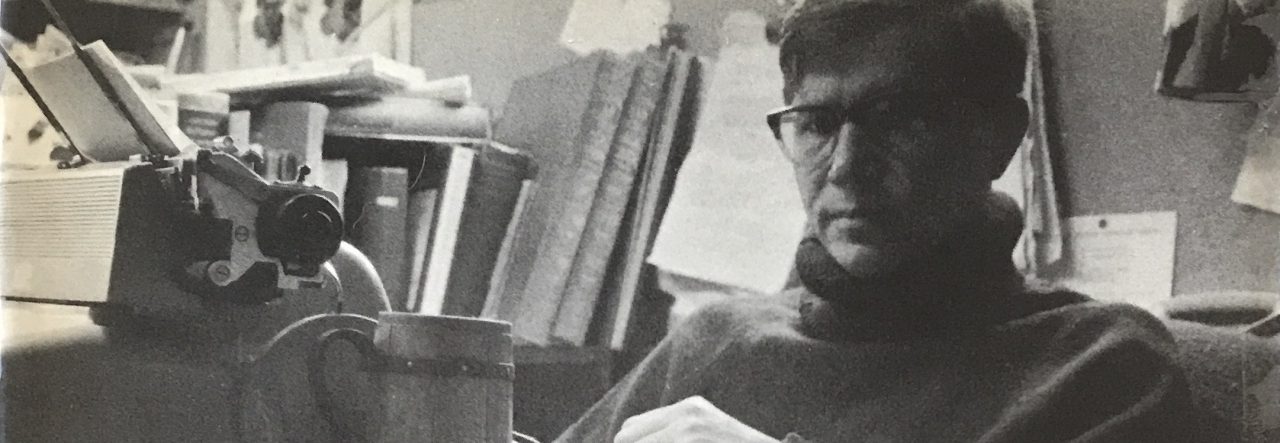
A new book of essays recently celebrated 70 years of Colin Wilson’s debut – it is available here [Colin Wilson Studies # 37]. I don’t yet have a copy of this but as a show of support here are some of my own thoughts on The Outsider. 

The Outsider is three score and ten this year, a Biblical lifetime. Most amazingly, it is still in print; not bad for a book about the vagaries of consciousness by an unknown working class youth (would this kind of thing happen now? Of course not). In the public imagination Colin Wilson’s name will be for ever and always linked with this one book and its rather scandalous success which was followed by a critical turnaround and berating by the Establishment. But truth be told it’s not even his best book – it is after all only the first part of seven (the ‘Outsider Cycle’ ran from 1956 to 1966). While a close reading of The Outsider shows it contains many of his later concepts in embryonic form (for instance, the development of “a certain faculty” which “increases […] the sense of other times and other places”), a useful solution toward the problem of everyday life-failure that the book addresses would only become apparent as the series reached its conclusion. (The mysterious faculty he refers to would be thoroughly examined a little later in Wilson’s next bestseller, a wonderfully entertaining ramble through ‘occultism’ in 1971). 

“I wrote The Outsider to try to express what is wrong with us” remarked Wilson in a 2005 interview with Philosophy Now. And what is wrong with us? Our consciousness, which is forever selecting and cutting out wider meanings. For Wilson, this quirk of human perception is paradoxically responsible for both our swift evolutionary progress and for all the whining nihilism that contradicts it. He explains that the average person, “looking at himself from what Husserl called ‘the natural standpoint‘, doesn’t feel there is anything much wrong with him. But some men develop a curious inner dissatisfaction, which may amount to a vague feeling of ‘Who am I?’” This, Wilson explains, is implicit “in the ultimate ‘existential’ question” and may lead to “the possibility that ‘I’ may turn out to far more than I had assumed”. It is this “curious inner dissatisfaction” that is the concern of The Outsider rather a study in mere social awkwardness (which Wilson describes in the book as an Outsider’s “obvious abnormality, his introversion”). Another layer of the book argues that ‘Outsiders’ need to stop being ‘outside’, socially, and play their necessary role in civilisation, but this is secondary to the individual psychological analysis; the former concern is examined in the second and third volumes of the series and more thoroughly in his later books, such as New Pathways in Psychology and Order of Assassins.  

Wilson examines his Outsiders through biography and quotations from various writers, poets and thinkers to illustrate an active or ‘lived philosophy’. For this he has been criticised, in his defence he has pointed to Ernst Cassirer and Karl Jaspers, both of whom used this method without harming their philosophical credentials. But no matter, for the keen reader Wilson’s argument is clearly expressed throughout the book. An ‘Outsider’ has a strange, rather distressing and uncertain sense of “unreality” about everyday reality, a permanently nagging dissatisfaction with the poker faced grain of the world, ‘reality’ as seen through Husserl’s ‘natural standpoint’, the viewpoint of the “normal individual” or “naive man” as Husserl had it in 1900.

The argument of The Outsider is not far from Husserl’s own, except Wilson was not aware of his philosophy until a few years later. He admitted that his discovery of the philosopher didn’t really make much of a general difference to his efforts as he’d been concerned with transforming everyday consciousness into something more meaningful since childhood. He also observed that Husserl’s ideas had already been anticipated by Blake and Nietzsche, two classic ‘Outsiders’. However, Wilson’s investigations into the genesis, development and practicalities of Husserl’s phenomenology gifted him a rigorously workable method to help solve these ‘Outsider’ problems, just as his acquaintance with Prof. Maslow’s self-actualising humanistic psychology or Sperry and Ornstein’s split-brain theory, to name only a few, would later. 

At the end of the eighth chapter Wilson comments that an Outsider believes that he – or she [1] – can establish a permanent way of seeing into themselves and solving these problems. ‘But how?” he asks. “By establishing a discipline to overcome his weakness and self-division”. Most people are – as he would explain in the third volume of the ‘Outsider’ series – what sociologists label ‘outer-directed’: “put them on a desert island with nothing to occupy their minds and they would go insane”. Conversely, and with some amount of terminological irony, ‘Outsiders’ are ‘inner directed’. In The Outsider Wilson continues by quoting Kierkegaard’s famous existential parable of bored Gods creating bored humans, but he remarks that although this is indeed a penetrating commentary it isn’t a particularly useful observation. Truth be told Wilson always thought Blake more original than Kierkegaard, and his life and ideas more dynamic. “Blake’s solution was: Go and develop the visionary faculty. Good. But how?” 

The philosopher John Shand has quoted another philosopher, Prof. Stephen Clarke: “Wilson does have some interesting ideas about attention, inattention and boredom. Indeed I don’t know any other philosopher who has had more to say about that very philosophical disease.” This disease or perceptual vicious circle is well summarised in a line from Ezra Pound’s Canto XV: “inchoate error, boredom born out of boredom” (it’s no coincidence that Pound is here railing against the “british weeklies” that would praise, damn and ignore Wilson later). Shand explains that the “key to Wilson’s thought is that we are led to nihilism by a fundamental philosophical mistake. That mistake is not to examine our minds, consciousness, first before we judge what the world is like”. When asked by The Times, again in 2005, what advice he would like to pass on, he answered “never give up. It cannot be said too often”. The suicides, tragedies and mental collapses documented and examined in The Outsider illustrate why developing this mental tenacity is important. Shand comments that “Wilson’s life indicates what can be done through taking one’s consciousness in-hand and through self-discipline refuse to sink into torpid despair at the vicissitudes of life. [He] has worked for fifty years without the handy financial and ego-enhancing props of regular academia, and survived the turbulence and vagaries of fashion”. Shand also admires Wilson’s formidable drive, “getting up every day at six and writing daily for hours productively in most literary genres”, noting how intertwined his philosophy is with his life. “‘You want to know about my ideas and I’ll tell you about my life,’ he says”. Wilson was as much of an Outsider as anyone he wrote about. 

“The Outsider’s first business is self-knowledge” explains Wilson early in his book. However, this is not merely a literary pursuit: “the point I wish to make here is the fact that the ‘way’ [i.e. ‘the method’] is not a matter for words, but a matter for action”. This self-knowledge “must be lived”. An Outsider needs to “find a course of action in which he is most himself” and “change only his relation to his ‘inner-self’”, or “true ‘I’”, the latter term being an interesting one, as it was used by Husserl twenty years before in his final book. Significantly, Husserl also explains there that his phenomenological philosophy can offer “a completely different sort of waking life” consisting of a transformation of consciousness “which breaks through the normality of straightforward living”. This was also the claim of another Outsider, Gurdjieff. Similarly Wilson points out that once ‘outsider-consciousness’ begins to ferment “the world can never afterwards be quite the same straightforward place”. And indeed, it isn’t.

Wilson’s book is full of extraordinary people doing unusual and occasionally absurd things, but he does not regard these as mere eccentricities: “of course, people who are incorrigible self-dramatisers, like the young Nietzsche, are only trying to get themselves ‘outside’ the situation, and see themselves in the situation objectively”. A perfect illustration of the first discipline in Husserl’s phenomenology, the famous epoché or ‘standing outside’, then. As noted earlier Wilson rejected the common interpretation of an ‘Outsider’ as a mere misfit and the notion of this problem being only a social one is questioned in the first sentence of the book (“At first sight…”). This becomes more apparent as the ‘Outsider’ series progresses. “As a social type, the ‘outsider’ may be vague; as a description of a state of consciousness definable by phenomenology, it is precise” [Beyond The Outsider, p. 163]. This subtle distinction is so often misunderstood that I have to repeat it: ‘Outsiders’ – or ‘outsiders’ by 1965 – wish to get themselves outside their everyday situation, to see it objectively. This is the intent of whatever “course of action” they choose to live out, be it Blake etching his Illuminated Books through the night, Nietzsche dropping out of academia to seclude himself in cheap rented rooms or the famous Lawrence of Arabia deciding to become ‘John Hume Ross’ for a few weeks. 

Twenty years after his first book was published Wilson recognised what, despite the furore, it was all really about: it was “the realisation that I had at last settled down to the serious business of living”. Looking back even further, in 2001, he cheerfully admits that his outlook is “now more pragmatically optimistic” than it was in 1956. The “serious business of living” is the living philosophy (the ‘new existentialism’) sketched out in The Outsider, developed through the series that followed and examined thoroughly in his best later works, non-fiction and fiction. “The philosopher starts from the sense that there is a lot of illusion about the world, and that his task is to probe to the reality” wrote Wilson in an essay about Tolkien. Existential and phenomenological philosophy are of course intertwined with the ‘reality’ that we face everyday, and the latter, in particular, offers pragmatic solutions on how we can change it, at least – at first – on an individual level. Wilson’s ‘new existentialism’ offers a coherent living philosophy for the ordinary reader, and the book of that name (1966) features disciplines and exercises based on the phenomenological method which can be utilised by “anyone who goes to enough trouble”. [2] Therefore, is it “not illogical to suppose” asks Wilson in The Outsider “that a development of the same faculty [of selecting, i.e. Husserl’s epoché] might lead the practical-minded European to see things where he saw nothing before”? Even though he clearly analysed it in two etched pamphlets on religion circa 1788, Blake seemed to posses this faculty instinctively, but as far as Wilson was concerned it was essential that some of us develop it in the daylight of ordinary consciousness. “It is necessary for at least a few men to develop a new type of consciousness, to develop it slowly, painfully, instinctively” he writes near the end of the book. “Would not such a man be a complete Outsider?”

[1] See Outline of the Female Outsider, volume one in the ‘Abraxas Collectors Series’, St. Austell, 1994. Some female Outsiders: Emily Brontë, George Sand, Mary Wollstonecraft, Marie Bashkirtsheff, Dora Carrington, Isadora Duncan, Virginia Woolf, Phillipa Burrell… This would have been a very interesting second volume complementary to The Outsider, had it been completed (circa 1991). 

[2] In fact, this is a line from the previous (sixth) volume of the series, Beyond The Outsider (Arthur Barker, 1965, p. 82) explaining Husserl’s epoché. The slightly withering tone of ‘go on then, do it yourself’ never fails to amuse me. 

The relativism that liquefies all things

In the first volume of his Philosophy, an early (1932) work of the nascent Existentialist movement, Karl Jaspers argues “I do not become myself by smashing what is universal”. Weary of what he paradoxically describes as a “universal relativism” – the idea that anything and everything is valid from a viewpoint “which I can take, abandon and change” – he wryly explains that we can be at home in any standpoint “without standing for any”. The result of this ‘freedom’, he clarifies, is that we lose our genuine sense of self.

The novelist Robert Musil also noticed this rather self-indulgent psychological paradox around about this time when he described “the general obsession with turning every viewpoint into a standpoint and regarding every standpoint as a viewpoint”. Today this is known as ‘standpoint theory’. With roots in second-wave feminism, Foucault and Farnon, this ideology has stridently assured itself that it can realise full self-actualisation by smashing anything ‘universal’. It is therefore almost uncanny to read Musil’s novel The Man Without Qualities – from which the above quote is taken – and be told that “reason and progress in the Western world would be displaced by racial theories and street slogans”. With deadly accuracy, he described this “storm of aimless struggles” as merely “playacting”, a “splendid new gesture” or “vital pose” which “offers that moment of self-realisation”. Imagine, he writes, “what it is to have a heavy world weighing on tongues, hands and eyes […] and inside nothing but an unstable, shifting mist […] what a joy it must be whenever someone brings out a slogan in which one thinks one can recognise oneself”. Gurdjieff described this empty-headed banner waving as the “glamour of new slogans”. Like Musil and Jaspers, Gurdjieff was reacting to the chaos of a century ago. But again his words are are prescient. “There are periods in the life of humanity, which generally coincide with the beginning of the fall of cultures and civilisations, when the masses irretrievably lose their reason and begin to destroy everything that has been created by centuries and millenniums of culture”. These periods of “mass madness” he says, often coincide with “geological cataclysms, climatic changes, and similar phenomena of a planetary character”.

In A Criminal History of Mankind (1984) Colin Wilson defines relativism as the essence of the criminal mentality, presenting an abundance of ruined lives as examples. “You can’t say it’s wrong to kill. Only individual standards make it right or wrong” confided the murderer Melvin Rees. This, of course, is the logical conclusion of treating every viewpoint as a standpoint and vice-versa. But as Wilson observes, permitting free expression of such negative emotions is “the emotional counterpart of physical incontintence” with the result that the “inner being turns into a kind of swamp or sewage farm”. Aware of this baleful putrefaction of our objectivity, Jaspers describes it in a queasy but accurate phrase that sounds like a line from Arthur Machen’s The Novel of the White Powder – “the relativism that liquefies all things”.

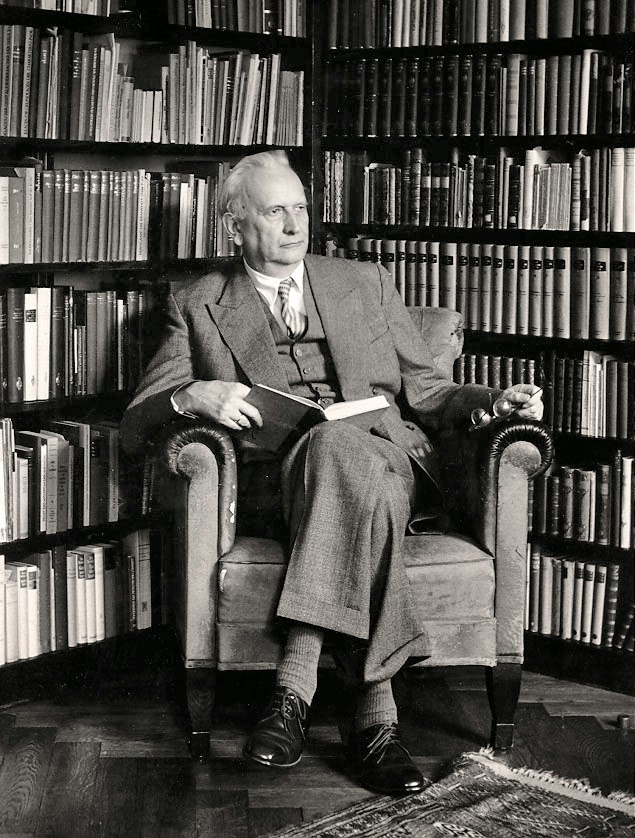
Karl Jaspers

Jaspers first came to attention in 1923 with his bulky tome General Psychopathology. Regarded as a significant landmark by Wilson in The New Existentialism (p. 108), it must be one of the first books to attempt to understand the criminal mind using the new techniques of phenomenology as developed by Jaspers’ contemporary Edmund Husserl circa 1900 (in Criminal History Wilson describes Husserl’s phenomenology as “the most important philosophical insight of the twentieth century”). Section V § 3 (b) of Jaspers book tantalisingly references studies on the “psychology of women poisoners” and “homesick girls who committed crimes”, and the first chapter, ‘Subjective Phenomena of Morbid Psychic Life (Phenomenology’)’ clearly shows the influence of the older thinker.

A 1955 Epilogue introduced the English translation of Jaspers’ three volume Philosophy. He recalls that the “philosophy I sought at universities in 1901 disappointed me” but “Husserl impressed me most, comparatively speaking, although his phenomenological method did not strike me as a philosophical procedure”. At first he took it – as Husserl himself originally did – as a name for descriptive psychology, and it is this ‘static’ phenomenology that Jaspers uses to power the argument of his Psychopathology. Jaspers also confided that when he met Husserl in 1913 “I told him I still failed to understand what phenomenology really was”. Characteristically, Husserl replied that understanding was a “difficult matter” but reminded Jaspers that he was already using the method perfectly anyway. “Just keep it up” was his sage advice. But looking back, Jaspers remembered that he had long rejected – in no uncertain terms – the later phenomenology that Husserl was developing when they met.

However, in The New Existentialism Wilson informs us that “Husserl’s aim is basically identical with that of Jaspers” in that he wants to create a flexible, lived philosophy. “Jaspers wants us to grasp knowledge as a living process, and the human relation to it as dynamic” (Wilson makes similar remarks about Sartre and Heidegger in his paper ‘The Mescalin Experience’, noting that due to its phenomenological roots, existential philosophy is active, ‘kinetic’, rather than static). One particular method that Jaspers had at his disposal to demonstrate this action was biography; simply describing the lives of philosophers illustrates an active philosophy beautifully (“Socrates’ father was a stonemason, his mother a midwife” begins the first chapter of the first volume of Jaspers’ breezily readable The Great Philosophers, 1957). Wilson used this method often, from The Outsider on – my personal favourite example from that book is of the young Nietzsche throwing himself into a corner of his sofa and devouring a second hand volume of Schopenhauer. He acknowledged this particular debt to Jaspers early in his career [1] and later, in the ’90’s. In The New Existentialism he comments that the point of the three volumes of Jaspers’ Philosophy and the many volumes of The Great Philosophers is “to encourage the human mind to grasp its place in the great forward movement of the spirit”. Similarly Wilson’s The Outsider outlines the need for a lived philosophy in the fourth chapter.

Yet Wilson brands Jaspers “a failure” in The New Existentialism. In the sense that he meant it – of not really passing on vital results to philosophical successors, he is correct (Jaspers is little read today, even in philosophy departments). Then again, despite his obvious interest, Wilson describes the entire original ‘old’ (sic.) existential movement a failure a mere six pages later. But he insists that this is due to Jaspers, Heidegger, Sartre and Camus abandoning the important central insight of Husserl’s phenomenology which Wilson paraphrased as ‘perception is intentional’. Husserl’s advice to just keep up these disciplines even if Jaspers rejected them professionally was very honest and practical. Just keep it up could be a motto for Wilson’s own ‘new’ or ‘phenomenological existentialism’. “One of the reasons that the ‘old existentialism’ found itself immobilised was that it tried so hard to compromise with academic philosophy” observes Wilson, offering Jaspers as an example. Conversely Wilson’s The New Existentialism is written for “the ordinary intelligent reader”.

An important insight Wilson made in 1965 is that using the methods of the new existentialism – which are clearly described in the book of that title – involves the eventual recognition that that the truth is ‘within’ (subjective, as Kierkegaard observed) but it is not relative (Beyond The Outsider, p. 165). Heidegger defines the phenomenological method in Being and Time [§ 7] as one which does not subscribe to a single dogmatic standpoint. His teacher Husserl cheerfully waved away relativism in the introduction (Prolegomena) to the Logical Investigations, describing it as “a bare faced and (one might almost say) ‘cheeky’ scepticism” before patiently demolishing the arguments for relativism (‘psychologism’) piece by piece. “The essential core of this objection lies in the self-evident conflict between relativism and the inner evidence of immediately intuited existence” [Husserl, ibid. § 36]. In other words, relativism cannot accurately describe our inner states or existence, and taken further this relativistic attitude distorts everything. “The relativity of truth entails the relativity of cosmic existence” [ibid]. This attitude of universal relativism was espoused by Lovecraft in The Call of Cthulhu, with its famous opening line about the human mind being unable to correlate all its contents (a sentence which would have made Husserl grimace). In Order of Assassins (1972) Wilson postulated that had Lovecraft lived a little later, he could have included the ‘relativistic’ crimes of the serial killing age (“You can’t say it’s right or wrong to kill…”) in his panoply of unfolding horrors (“New York policemen are mobbed by hysterical Levantines” is one unintentionally funny line from the tale). Truth be told, Lovecraft’s Cthulhu Mythos is a better illustration of “the relativism that liquefies all things” than anything by his master Machen.

Refuting this kind of shallow relativist view, explains Husserl, requires “the leverage of certain self-evident, universally valid convictions” [ibid. § 35]. From the start to the end of his career Wilson never gave up his conviction that we are living in the midst of an unseen perceptual revolution, holding a firm belief in an imminent evolutionary leap aided by intellectual investigations. This position, he admits in Beyond The Outsider (p. 181), is ‘strange and uncomfortable” unless our mental faculties are powerful – “the kind of power that can be given only by a deep conviction”. In previous religious ages these convictions were widely if naively held. Now the quest for the ‘transcendental ego’ gives us a conviction toward the possibility of ‘mystical’ experiences without ritual or yogic embellishments. Husserl referred to these layered powers as “hidden achievements” and our job – as phenomenologists – is to uncover and use them. Wilson sees the hidden achievements of this ego as evolutionary, a drive toward complexity.

The ‘transcendental” phenomenology that Jaspers rejected was detailed in Husserl’s Ideas, published the year they met. The second chapter of the third part is titled ‘Universal Structures of Pure Consciousness’ and begins by describing this ‘structure’ or “realm of transcendental consciousness”, a primal region of absolute being in which relative mental states are merely dependant (and therefore not ‘universal’). As quoted in Herbert Spiegelberg’s The Phenomenological Movement (p. 160) and Wilson’s The New Existentialism (p. 62), Husserl later alluded to this mental space as the universalist domain of the transcendental ego and the ‘keepers of the key to the ultimate sources of being’ with reference to Goethe’s Faust. It sounds abstract and almost mystical – and let’s face it, exciting, which is perhaps the point – but Husserl is essentially describing a practicality, a ‘normal’ consciousness shorn of relativist prejudices – via his famous epoché – which leads to the mental state he describes as the ‘transcendental ego’. This is not a mystical ineffability but rather the beginning of clear philosophical thinking and it is analogous to Wilson’s observation that we recognise that the truth is within but is not relative. Husserl often reminded us that this phenomenological change starts with a change in attitude – Wilson’s ‘recognition’ (this word also forms an important insight at the very end of his 1997 book about the Sphinx).

Wilson’s slim 1980 monograph on the bicameral brain, Frankenstein’s Castle, describes this ‘switch’ from another angle. Referencing a theory of Howard Miller, an American doctor intrigued by hypnosis, Husserl’s transcendental ego is described by Wilson as a confused ‘normal’ ego. “This conclusion left me slightly stunned” he admits. “It was not quite what I had been expecting. We have become so conditioned to thinking of the ‘intellectual ego’ as a villain that I found my explanation disturbing. Surely, the correct answer should be: the transcendental ego – some ‘higher self’ that presides over consciousness?” This appeared to be Wilson’s position throughout the latter stages of his Outsider Cycle (1956 – ‘66), in books such as The Occult, 1971, and for quite a while after. Even so, in the sixth chapter of Beyond The Outsider – a fascinating book on ‘evolutionary intentionality’, a process tied in with Husserl’s concept of the transcendental ego – we read that uncovering this process merely involves bringing it to consciousness (“it had already taken place”). In his Cartesian Meditations [§ 15] Husserl notes that we are “at all times a Transcendental Ego” but we only know that we are via the change of attitude. This phenomenological uncovering “is the act of going in search of the awareness long before it has reached the surface” says Wilson. The literary example that he gives is from Shaw’s Back to Methuselah; the maiden remarks to Strephon that “it is the realisation of it when it has actually happened” – ‘it’ being evolution, maturity. A theme that runs through Wilson’s work is that these happy discoveries appear to happen spontaneously without much control. Therefore Wilson thinks it is difficult to imagine exactly what type of creature ‘phenomenological man’ could be if he could completely uncover his intentional evolutionary structure and make these faculties a normal part of his consciousness (he later surmised that the results would likely be unpredictable but immense). The title of a later Wilson essay ‘Husserl and Evolution’ makes reference to this, as does his explanation that discovering Husserl’s “nonrelative philosophy” only made him aware of a process he had already been using. A recognition as much as a discovery. 

Wilson describes Husserl’s phenomenology as an investigation into meaning. Therefore the starting point for this uncovering, explains Wilson, is a sense of meaninglessness, the classically existential type expressed in the opening sentence of his second autobiography Dreaming To Some Purpose. Jaspers notes in the third volume of Philosophy that the following states are contrary to meaning: “dissolution, death, lawlessness, crime, insanity, suicide, indifference, haphazardness” and last but not least, “absurdity”. All these dark themes are grappled with in Wilson’s writings and perhaps the key word here is ‘indifference’. Wilson’s notion of the ‘indifference threshold’ – our ‘normal’ state of consciousness where discomfort (or far worse) can stimulate us into happiness whereas comfort or even luxury bores us or makes us miserable – is vividly illustrated in his A Criminal History of Mankind. Like his book on the Sphinx, Criminal History has as its subtext the growing dominance of the careful but anxious left cerebral hemisphere over the ancient, pleasantly intuitive certainties of the right. This lopsided change was already observed in Beyond The Outsider with reference to Whitehead’s philosophy, but the paradox of the indifference threshold was best summed up in a line from Wilson’s book on the psychologist Maslow: that consciousness without crisis tends to become negative – a kind of psychic festering.

Jaspers argued that we know ourselves only in ‘boundary-situations’ – Foucault would later label these ‘limit-experiences’ – such as “death, suffering, guilt, the sudden violent accident” (The New Existentialism, p. 23; the concept is fully explored in the second volume of Jaspers’ Philosophy). But these – especially the last, haphazard example – surely are the same states, more or less, that he later regards as meaningless. Similarly both Heidegger and Gurdjieff thought that a grim realisation of impending death would ‘wake us up’ from our mechanised slumber – Dr. Johnson even had a cheerful quip about it – but Wilson sees this insight as poor phenomenology. Husserl wished to analyse mental states independent of the object or situation they were observing – technically, separating the noesis (perceptual acts) from the noema (content, or objects of intention). Wilson makes the interesting observation regarding this analysis by imagining what Husserl would have said about William Blake’s poetic philosophy in his 1965 essay ‘Phenomenology and Literature’, suggesting that we pursue the matter further by consulting the relevant texts. Apart from the fact that reading Blake makes one immediately aware what Wilson meant by the poet’s anticipation of phenomenology, Husserl thought [Ideas § 49] that the ideal phenomenological epoché would lead to nothing less than an “Annihilation of the World”, a psychic apocalypse which still leaves transcendental consciousness untouched. This is way beyond Foucault’s ‘limit-experiences’ but well within Blake’s imagination. A rare 1995 document containing marginalia from Wilson’s own copy of Introduction to The New Existentialism contains insights of a similar nature, questioning the ‘fake’ conscious mind and ruminating on the possibility that birth and death may be ‘intentional’ anyway (on the last page of his copy, Wilson had underlined his sentence “death may be a disguised form of suicide”). Further clues toward understanding this fascinating idea can be found in Wilson’s Afterlife and his biography of Rudolf Steiner, both from 1985.

Husserl’s thought experiment about the ‘annihilation of the world’ illustrates how far reality depends on perception. Accurate perception for Husserl, like Blake before him, depends on its intensity [see Logical Investigations, V § 19] or how accurately the perceptual arrow hits the object. When it does, it is “meant” [ibid. V § 21] and not partial or relative. Husserl goes on to say that this intwined ‘meant’ perception involving the act and content is correlative, a view which opposes Lovecraft’s bleak cosmic interpretation in the opening lines his Cthulhu story. Introducing his theory of ‘Faculty X’ (aka the ‘phenomenological faculty’) in The Occult Wilson remarks that we can only mean things when this Faculty is operative or as Husserl would say, we are in the phenomenological attitude. Wilson’s choice of Proust’s moment of insight in Swann’s Way as a perfect example of a faculty which reveals the reality of other times and places was insightful as Proust describes it wonderfully. It was “indisputable evidence [of] it’s reality […] in whose presence other states of consciousness melted and vanished”. It was, he recalls, a “neutral glow” – pure consciousness, identical to the universalist mental realm which Husserl delineated in Ideas.

Wilson informs us in The New Existentialism that the practical way toward this phenomenological universalism involves becoming constantly aware of the intentionality in all our conscious acts, hardly an impossible task. Here (p. 101) and in the previous ‘Outsider’ volume, Beyond The Outsider (p. 82) he insists that this can be done by anyone who goes to enough trouble. ‘Just keep it up’, as Husserl once said. Maslow explained that his patients had frequent ‘peak experiences’ the more they discussed them. Similarly Wilson noticed that “most people have insights to this effect [i.e. regarding ‘intentionality’] at least once a week”. We must, says Wilson, investigate these and give them philosophical weight (which of course, is exactly what he did). “One we see this clearly” he comments in The New Existentialism, “it becomes astonishing that anyone bothers to argue about it”. For anyone who can be bothered to take these disciplines seriously, that sentence is wryly amusing.

Wilson’s Order of Assassins ends with a thought about what happens when we are deprived of these larger meanings: we turn to sloganeering messiahs and führers and eventually turn bitter and violent. Against the rather helpless feeling that society has about such problems – and at the moment, it’s more of a rather drab, generalised sense of stasis or treading water – Wilson ended Criminal History by remarking that “all the major transformations in society have started with the few who know better”. And in the last paragraph of his Beyond The Occult he states that this will remain so until we stop merely marking time.

Notes.

[1] “Jaspers is a better existentialist than Heidegger, for at least he keeps his attention focussed on men like Van Gogh, Nietzsche, and Dostoyevsky“. Colin Wilson, Religion and The Rebel, Gollancz, 1957, p. 298.

Works used:

Heidegger, Martin: Being and Time, Harper Collins, 1962

Husserl, Edmund, Cartesian Meditations, Springer, 2012

Husserl, Edmund: Ideas (book one) Marcus Nijhoff, 1983

Husserl, Edmund: Logical Investigations (2 volumes), RKP, 1970

Jaspers, Karl: General Psychopathology, Manchester University Press, 1972

Jaspers, Karl: The Great Philosophers, Harcourt, Brace and World Inc., 1962

Jaspers, Karl: Philosophy (3 volumes), University of Chicago Press, 1969-‘71

Lovecraft, H. P.: The Haunter of the Dark, Panther, 1970

Machen, Arthur: Tales of Horror and the Supernatural, Volume 2, Panther, 1975

Musil, Robert: The Man Without Qualities, (2 volumes) Picador, 1995

Ouspensky, P. D.: In Search of the Miraculous, RKP, 1950

Proust, Marcel: Swann’s Way, Vintage 1992

Spiegelberg, Herbert: The Phenomenological Movement: A Historical Introduction (2 volumes), Marcus Nijhoff, The Hague, 1976

Wilson, Colin: A Criminal History of Mankind, Mercury Books, 2005 (updated edition)

Wilson, Colin: Afterlife, Caxton, 2000 (updated edition)

Wilson, Colin: Author’s Emendations to Introduction to The New Existentialism, Maurice Bassett, 1995

Wilson, Colin: Beyond The Occult, Corgi, 1989

Wilson, Colin: Beyond The Outsider, Arthur Barker, 1965

Wilson, Colin: Existentially Speaking, Borgo Press, 1989

Wilson, Colin: From Atlantis to the Sphinx, Virgin, 1997

Wilson, Colin: New Pathways in Psychology, Gollancz, 1972

Wilson, Colin: Order of Assassins, Hart-Davis, 1972

Wilson, Colin, Religion and The Rebel, Gollancz, 1957.

Wilson, Colin: Rudolf Steiner: The Man and his Vision, Aquarian, 1985

Wilson, Colin: The New Existentialism, Wildwood House, 1980

Wilson, Colin: The Occult, Panther, 1978