
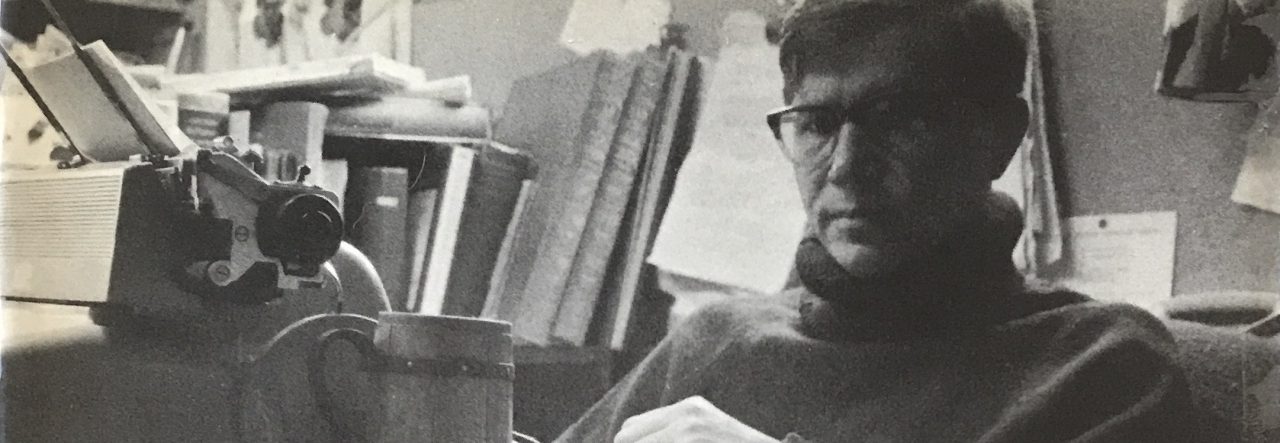
In Wilson’s critically mauled second book Religion and The Rebel (a “rubbish bin” that has turned out to be full of treasure) there is an interesting aside about Ludwig Wittgenstein’s inability to stop talking and start doing – doing being “the Outsider’s discipline” (as per The Outsider itself where the concern “is essentially a living problem”). Wilson finds Wittgenstein’s ‘doing’ – giving away his fortune, working as a schoolmaster, gardener’s assistant, architect and as a leather-jacketed academic – as unsatisfactory as Robert Musil’s anti-hero Ulrich found such things in The Man Without Qualities and as dull as Wilson found his own traipse around factories and offices in his teens. Clearly, ‘doing’ is more than what we presume it to be. It needs a discipline.
In the late fifties and early sixties Wilson found Wittgenstein’s linguistics useful but not as practical as Husserl’s phenomenology and, despite some reservations, pitted existentialism against the now disregarded school of logical positivism, a kind of Wittgenstein-lite with A. J. Ayer as its figurehead. “Logical positivism struck me as a kind of deliberate murder of everything important in philosophy”. [1] Even so, Wilson describes his own phenomenological ‘new’ existentialism’ as “Anglo-Saxon and empirical rather than ‘continental’ and metaphysical”, reminding us that a “phenomenologist might be an existentialist or a logical positivist”. He also assures us that one notable facet of his philosophy “is that it is able to unite the two major traditions of twentieth century philosophy: linguistic empiricism and phenomenological existentialism”. Certainly, his Introduction to The New Existentialism – from which the above correlations are taken – is stylistically closer to a delightfully ‘Anglo’ text like Gilbert Ryle’s The Concept of Mind (1949) than with the continental heavyweights (Jaspers, Husserl, Heidegger, Sartre, Merleau-Ponty) he is discussing.
By the time Wilson wrote The Misfits in 1988 he had pretty much rejected Wittgenstein’s ideas as “the philosophy of a child who is afraid of the dark” but he maintained his admiration for Husserl’s method. Looking at the chaotic emotional lives of thinkers in that book we can understand why Wilson had said in 1957 that the best life for a philosopher is an uneventful one. He was speaking of A. N. Whitehead, but could have been referring to the settled domesticity he had then began to enjoy in Cornwall after the succès de scandale of The Outsider. When I visited for the first time in 2007 Wilson told me – with a chuckle – that he agreed with Thomas Mann’s assertion that the best creatives live ‘bourgeois’ or rather, orderly lives (Mann calls this “the bourgeois acceptance of life” in The Magic Mountain). So, with typically punctual satisfaction Wilson ends his second autobiography with the words “it is four o’ clock on a winter afternoon, and time to take my dogs for a walk”.
In a passage near the end of that book Wilson sums up his aims. “I concentrated on trying to create my own version of exceptional human experience, and to enable readers to absorb that experience through the medium of imagination”. Here he is strictly speaking of his fictional output but his best non-fiction work also performs this function, and often performs it superbly. In Mysteries Wilson remarked that when reading Proust “we have a sense of excitement, a feeling that he was on the right track” with his attempts to recreate his past. I feel that Wilson’s best work was similarly on the right track and it generates the same sense of excitement, the knowledge that intentional perception can subtly transform almost anything we encounter. “Any interest” he writes “has this power or releasing vital reserves. It has to do with the amount of energy we put into perception”. [2]
This intentional perception is “the Outsider’s discipline” as Wilson precisely defined what an Outsider was as the Outsider series progressed. In the sixth volume it is finalised as a “fundamental concept […] a description of a state of consciousness definable by phenomenology” and not as the vague social type that it was presumed to be by casual readers. The state of consciousness definable by phenomenology is the opposite to the kind wryly portrayed by Sartre’s character in Nausea who is dependent on outward objects and social situations for meaning. A reader who understands Husserl’s demand to separate the intentional act from it’s object is performing the Outsider’s discipline, aiming to live on “an inner reality, independent of the present, sustained from within”. Wilson hoped that one day “we shall all be phenomenologists”, able to “use literature as a useful instrument for turning phenomenology into a living reality”. And if this sounds too fanciful, he simply warned that “under-energised thought will actually falsify the objects of perception”. [3]
This latter observation explains his fascination with true crime, criminals being particularly susceptible to the materialist fantasy that a satisfying meaningfulness only corresponds with the pursuit of outward objects. It is also relevant to his interest in ‘the occult’ (occluded or hidden levels of perception) when he renamed the ‘phenomenological faculty’ Faculty X, the ability to energise thought in order to live “independent of the present”, to understand the reality of otherness and other times and places. Wilson assures us that this ‘faculty’ can be trained as an athlete trains the muscles for a sporting event. His own best work cross referenced with the texts he recommends is a very good start toward this discipline.
This also matters in a broader sense because Wilson believed that phenomenology has “endowed human evolution with a conscious intention. It has revealed that man’s incorrigible craving for optimism and purpose can be justified on basic epistemological grounds”. He illustrates its practical application with an amusing story about Sartre, who roused his audiences to fever pitch by declaiming that they were free – ‘go out and claim your freedom!’ he would command. However this enthusiasm only lasted a few hours “because the audiences never knew what to do”. [4] For Wilson, like Husserl before him, the practical application of phenomenology is the discipline toward this freedom, this ‘doing’.
Wilson admired Sartre as a historical figure but he had his philosophical reservations. Despite starting out as a strict Husserlian, Sartre’s “thought is oddly soggy at the centre”, a kind of soufflé filled with old prejudices from childhood. “Somebody recently told me that the city of Tehran is built on a quagmire: so is Sartre’s philosophy”. [5]
So, what should have Sartre’s students done to maximise their freedom? “A convinced reader might lay down [philosophical texts] and sigh: ‘But what am I supposed to do?’ comments Wilson in Beyond The Outsider. A phenomenology based on Husserl and Whitehead can indeed solve this practical question, he answers. “What does a phenomenologist actually do?” he asks in Introduction to The New Existentialism. “He applies the phenomenological method to whatever may be his own field”, noting earlier that the disciplines and aims of the method are as varied as its practitioners. A section on practical disciplines in the latter book (p. 100) shows that the first step is to become constantly aware of the intentionality in all of our conscious acts. Truth be told, this not as dryly intellectual as it sounds, as the examples Wilson gives are: viewing a piece of political propaganda and attempting to sympathise with the side you oppose, or (Beyond The Outsider, p. 82) reading back a mean spirited message you have written as if you are the unfortunate recipient. “‘Moods’ make particularly good material for this kind of analysis” adds Wilson. “Anybody who took the trouble could compile a textbook of methods for developing such awareness”. Clearly, phenomenological disciplines are not abstractions, they are living solutions that wrestle with the problems of everyday life today. Introduction to The New Existentialism may be sixty years old this year but its relevance remains obvious to the open minded reader.
In 1984 Wilson was asked what he felt was wrong with human beings. “Basically I say that we are trapped in the here and now, and that we have allowed ourselves to be defeated by the here and now. Or, we’ve allowed all sense of direction to be taken away from us”. As an illustration he says this is like someone going into a room for some specific reason and then immediately forgetting why once the door closes. It is the remembering – “oh, of course!” – that is important. Psychologists call these recollections peak or flow experiences – ‘exceptional human experience’. Gurdjieff and Ouspensky practiced ‘self-remembering’. Proust thoroughly analysed remembering in À la recherche du temps perdu. Heidegger lamented ‘forgetfulness of Being’ [Seinsvergessenheit] in Sein und Zeit (Wilson paraphrases it as ‘forgetfulness of existence’). Wilson’s outsider-discipline of intentional doing can make these ‘obvious’ moments more plentiful.
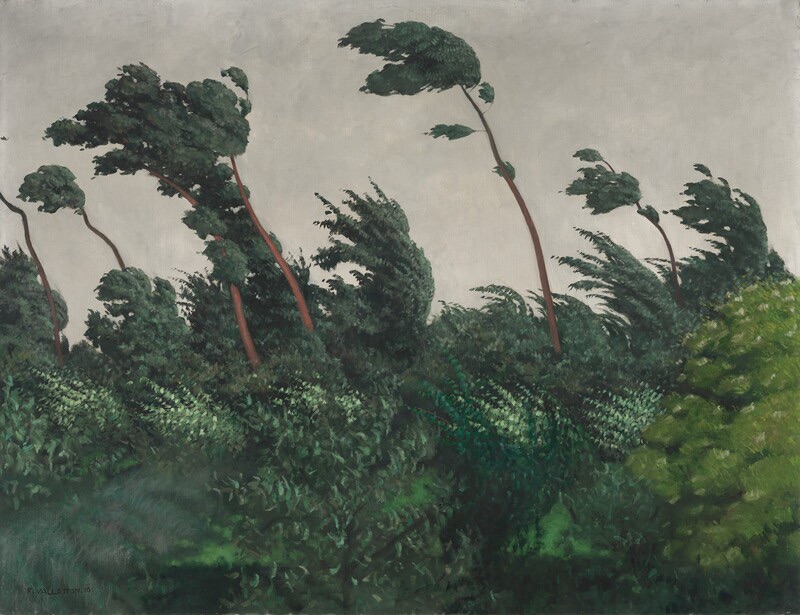
An even more interesting insight about intentionality appears in Wilson’s Access to Inner Worlds (1983). Wilson mentions an obscure but “very remarkable book” entitled Essay on the Origin of Thought by Juri Moskvitin, sent to him “by some unknown well-wisher”. The basic thesis, he explains, is a variation on Husserl’s insights on intentionality, but with an intriguingly creative twist. “What Moskvitin is saying is that when we ‘see’ something, we actually paint it”. The ‘painter’ is Husserl’s transcendental ego, a “creative self” to use Wilson’s term. Neither Husserl or Moskvitin are suggesting that the outside world does not exist, rather; intentionality creates the meaning of the world. To the aesthetically minded ‘painting’ the reality we see every day is a huge leap forward in understanding and using Husserl’s method of intentionality. The late David Hockney said “I have always believed that art should be a deep pleasure…there is always, everywhere, an enormous amount of suffering. But I believe my duty as an artist is to overcome and alleviate the sterility of despair…New ways of seeing mean new ways of feeling… I do believe that painting can change the world.” And another appropriate quote: “I think there is a contradiction in an art of total despair, because the very fact that the art is made seems to contradict despair”. In other words, ‘making’, active doing neutralise despair.
Notes.
[1] Quoted from ‘A. J. Ayer’ in Wilson’s Collected Essays on Philosophers, Cambridge Scholars Publishing, 2016, p. 1. Originally from the Daily Telegraph Magazine, Nov. 1st, 1969. Intriguingly, Wilson asked Ayer if he believed in life after death and he answered “I don’t expect to survive my death in any sense at all”. Nineteen years later Ayer admitted – again, to the Telegraph – that he had a near death experience. His recounting of this experience is ironically enlightening if unintentionally funny: he tried to get the attention of disembodied astral intelligences in true logical positivist style by gesticulating toward his watch. Alas, “they chose to ignore me”.
[2] Wilson, Colin, ‘Science Fiction and Existentialism’ in Existentially Speaking, p. 30, Borgo Press, 1989.
[3] Wilson, Colin, ‘Existential Criticism’ in Eagle and Earwig, John Baker, 1965, p. 58; ‘Phenomenology and Literature’ in ibid. p. 98. ‘Underpowered perception’ quote from ‘Dual Value Response’ in The Bicameral Critic, Salem House, 1983, p. 101. Here, and in the above note [2] it’s worth remembering that Husserl makes similar remarks on the need for an energetic perception in the Logical Investigations (RKP, 1970, p. 582).
[4] Both quotes from ‘Existential Psychology: A Novelist’s Approach’ in The Bicameral Critic, ibid. pp. 53-54.
[5] Wilson, Colin, ‘Arthur Koestler’ in Existentially Speaking, ibid., p. 61. Despite his harsh words, Wilson wrote an obituary for Sartre in 1980 which concluded that “this unhappy romantic-rationalist was one of the most exciting and brilliant figures in twentieth century literature”. Wilson, Colin, ‘A Sartre Obituary’ in Below the Iceberg, Borgo Press, 1998, p. 63.


Pingback: Seventy years of The Outsider – The Phenomenology of Excess