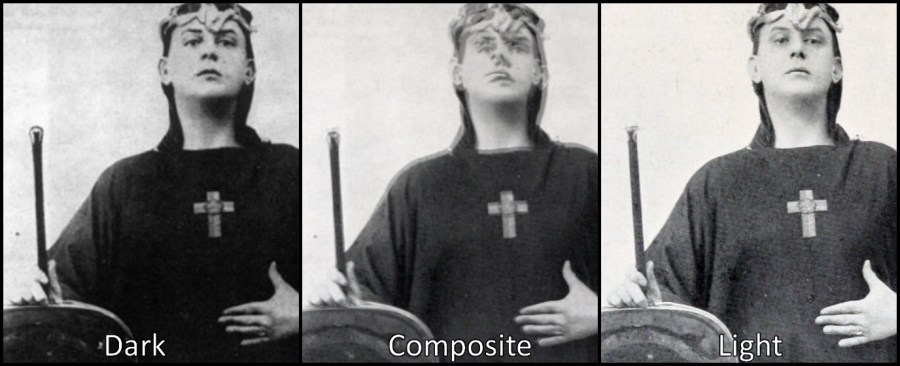
PSYCHOPATHICA METROSEXUALIS

Liber vel Bogus: The Real Confession of Aleister Crowley by Richard T. Cole. (TBC) If Colin Wilson were still around he would have doubtless recommended, if not introduced this unusual title.

 This soon to be released book has succeeded in causing some concern amongst custodians of Aleister Crowley’s legacy, but it deserves to be read by a much wider audience; it will be of interest to (Fortean) sceptics, psychologists, and possibly even criminologists (pages 30 – 32 have a expert diagnosis of Crowley’s severe personality issues, and there is a disturbing quote from his Magical Record which would be of interest to Operation Yewtree, were The Beast still living). Occultists with beliefs blowing in the direction of the 93 Current will perhaps find the details collated here somewhat unflattering to any idealised imagining of their guru, and in extreme cases (and not without a little irony) they may even suggest the book is libellous or possibly even ‘blasphemous’. Quite frankly, discrepancies and problems with Crowley’s development of his “Law” are nothing new to those familiar with his work and those of his closest commentators. The worst thing about Crowley that emerges from Liber vel Bogus is that he rendered a precise Existential, if not phenomenological truth, an essentially simple fact “for all”, obscure and possibly even impotent with an endless amount of misdirection. Coupled with unnecessary pretensions towards a full blown Messiah complex, Crowley is considered something of a fake outside of his clique. This book perhaps explains the latter reaction to The Beast’s unique career better than any biography, “hostile” or “unbalanced” ever could. 

Every study of Crowley’s extraordinary life will contain a variation of the following “fact”: that between noon and 1pm on the 8th, 9th and 10th of April, 1904, a “messenger from the forces ruling this planet” bearing the name Aiwaz (there are various spellings) dictated to Crowley the three parts of a work which, according to the scribe, would solve all of mankind’s religious and social problems. This book, Liber AL vel Legis A.K.A. The Book of the Law, is a brief work written in similar poetic style to Crowley’s previous efforts – certain symbols and concepts in it have already appeared in his earlier, less sensational poetic fiction. It is difficult to align the contents of Liber Legis with its alleged utilitarian effects, yet otherwise intelligent people continue to take it’s provenance and status as an objective, or perhaps spiritual, fact. Richard T. Cole’s study is a stern yet amusing corrective to such lazy acceptance, yet the discrepancies collected in his book – which deconstruct Crowley’s patchy narrative, one by one – are almost incidental to the analysis of Crowley’s attitudes and the detrimental effects these have had on the wholesale implication of his liberating creed, The Law of Thelema (which he considered to be more important than the wheel). A century after it’s supposed praeterhuman genesis, that all encompassing Law is practised only in a tiny corner of the remains of the counterculture, and Crowley is a very minor, if not invisible, figure in scholarship and academia (he continues to be perhaps the only occultist often referenced in popular culture, though this is something of a diminished return. It’s a long way down, creatively, from Kenneth Anger, Harry Smith, The Beatles and Throbbing Gristle to Robbie Williams and Peaches Geldof *) 

The discrepancies which Cole notes are fatal to any notion of genuine objectivity on Crowley’s part; nothing corresponds with Crowley’s own narrative of his crowning achievement; for such an important event, his actual recording of it is surprisingly vague. Crowley kept extensive diaries for the bulk of his life, recorded every other bowel movement, every fix, every desperate scheme for a few quid. Daily details regarding the genesis of the New Aeon are scant, missing or of secondary import to golf, of all things. The paper stock on which our new Bible is handwritten, supposedly at the dictation of Aiwaz on the selected days, is manufactured by Pirie & Sons, and it bears a watermark which actually dates the sheets to one year later than it’s alleged composition, i.e. 1905. The sheets have subsequently been backed with linen, probably, suggests Cole, to hide this flaw. A rumour abounds of two attempts existing. There are other serious problems, particularly with chronology. The Boulak Museum, Central to the reception myth, closed in 1902 when “an irreversible shift in the Nile transformed it into an impromptu swimming pool.” Relevant notebooks are also missing or have pages torn out. Crowley even mixes up his own chronology, subconsciously admitting an earlier date of composition (1902, rather than 1904). Photographs miraculously show his ageing process in reverse and Aiwaz himself suffers both memory loss and lack of basic numeracy skills. These are just a few examples. Readers wanting more (Cole has even more unpublished information) are best off reading the book, or visiting here where Crowley aficionados will rake over each and every accusation in peer-reviewed, scientific detail. But as noted, it’s the wood, not the bark patterns on the trees which are of interest. It’s not an accident that all of the “unbiased” biographies of Crowley get heavier and heavier on the minutiae – wow, did you know Crowley had a chauffeur? – and show a progressive disinclination to step back and perform a truly unbiased autopsy on Crowley’s motives. 

To get the most out of Cole’s book, a familiarity with Crowley’s work is necessary. A lot of the humour is as self referential as Private Eye, and will doubtless be as uncomfortable to fundamentalist Thelemites as that esteemed organ is to Westminster. However, even without knowledge of the obeah and wanga, Crowley stands accused of fraud. The contents of Liber vel Bogus could very well be a large boulder in the road towards academic acceptability for “Crowley studies”; a shame, as postmodernist lassitude has almost allowed the old goat into the academy. There is Nuit outside the text, after all. His portrait is a fixture of popular culture – for now anyway. But a scientist of consciousness who fakes the central document which ‘proves’ a new dispensation? That’s not science or even poetry – it’s deception along the same lines as Blavatsky and her Mahatma Letters. The question is –  why go to such lengths to deceive? Crowley’s April Fool prank ran until he was perplexed on his deathbed. 

In his absorbing study of false messiahs, The Devil’s Party (2001), Colin Wilson remarks that Crowley’s belief “that he was the messiah was undiminished. To have abandoned it then [i.e. at Netherwood, where he died] would have been a form of psychological suicide.” It is relevant to note that Wilson regards “messiahs” from Koresh and Manson to Shoko Asahara and Yukio Mishima (and more intriguingly, Derrida and Foucault) as individuals hiding their weaknesses behind “the mask of power”. “The Mask” (a term coined by Crowley’s own bête noire, W.B. Yeats) “is the front he chooses to show the world, often the opposite of his basic type.” According to writer Robert North, from “the few contemporary accounts of A.C. that we possess, his manner was pompous and his voice had a high, nasal pitch. He was “different” and people made fun of him behind his back.” A recording of Crowley’s voice certainly confirms the second assertion. The problem with the mask, continues Wilson, “is that it condemns the wearer to hatred and resentment. Why? Because a mask implies defensiveness…[this] combination of resentment and superiority is of course, the essence of criminality.” Wilson has suggested previously (in his Aleister Crowley: The Nature of The Beast, 1987) that Crowley’s mentality was borderline ‘criminal’ – resulting perhaps from a head injury after a homemade firework knocked him unconscious for ninety six hours, and Cole delves a bit further into this. “That Crowley survived at all, is almost miraculous. That he did not suffer irreparable neurological damage is unlikely in the extreme.” Cole backs this up with testimonies from a doctor specialising in mental health issues – “a patient exhibiting five of these traits is diagnosable as suffering from NPD. Throughout his life, Aleister Crowley exhibited chronic symptoms associated with all nine [criteria of Narcissistic Personality Disorder].” Measured against Robert D. Hare’s Psychopathy Checklist, Crowley scores an astonishing 38 points out of 40. And if this were not enough, application of Pincus and Lewis’ three tier principal of key triggers (psychiatric illness, neurological damage and childhood abuse) leave little doubt that despite his firm belief he was beyond human comprehension (an Ipsissimus, no less) Crowley was simply a very damaged individual. 

In what is possibly the only Crowley penned book of interest to the non-partisan reader, The Confessions (a vast, near thousand page work even in it’s edited form – an unexpurgated facsimile of what should have been the original text has been “in preparation” for a decade) The Beast tells his own embroidered version of his life up to the 1920’s. Yet this isn’t any mere “autobiography” – this is an autohagiography. A close reading of this remarkable document doesn’t really convince the reader of Crowley’s saintly status. At age fourteen – pretty much adulthood then – he literally thought a cat had nine separate lives, indulging in a moronic act of animal cruelty that illustrates the destructive literal mindedness that would blunt his reactions to almost every event in his life. Cole comments “[that] Crowley labelled this barbaric act of savagery as “science” is illustrative of the sheer scale and complexity of psychological self-defence mechanisms he employed to conceal unresolved issues […] That Crowley simply assumes readers will accept his word at face value, and not see ‘the cat incident’ for the act of outright sadism it so obviously was, merely emphasises the severity of his repression, denial and increasing divergence from reality.” Unfortunately for our clear eyed, objective scientist, it gets worse. 

An incident quoted on page 40 of Cole’s book sums up Crowley’s pseudo aristocratic attitude towards women and the proletariat. The fact that Crowley was still rubbing his hands with glee over this reprehensible act decades later simply reinforces at the very, very least what an appalling snob he was. Sections from his Magical Record (quoted here for those with a strong stomach) would be interesting to officers dealing with the fall out from the Savile sex abuse scandal, and let’s not forget – selected verses from his own Koran would most certainly be noted by the other “ISIS”. But don’t complain, because who was it who whined that “I want blasphemy, murder, rape, revolution, anything, bad or good, but strong”? 

So how does Crowley get taken seriously as a neutral recording mechanism of divine truths when he’s so obviously – at the very least – riddled with prejudices? Crowley supporters will usually perform their favourite act of moral bifurcation and suggest we forget what an awful person he was, and just concentrate on textual analysis, or perhaps counter with a vaguely faux-naive statement like ‘that’s just how people were in those days.’ (They most certainly weren’t). When Crowley scores an unusually high mark on Robert Hare’s Psychopath Test, and if Crowley is a documented racist, sexist, animal abusing coprophiliac fraudster  –  with allegations of paedophilia and the author (author, don’t go blaming any “praeterhuman” intelligences) of a ‘holy’ book which contains lines corrosive enough for a very, very serious fatwa – the only option is to pray that these ‘foibles’ will wither away unnoticed, and bend over Nuitwards to counterbalance this information with an idealised portrait of ‘chess master, mountaineer, mystic, book designer, and poet.” 

To turn away from the reality of who Crowley actually was, what he did, what motivated him, and into this idealism, is not a way to discover the truth. Just as defenders of Heidegger will tie their very Daseins into philosophical knots to prove that he wasn’t really a Nazi, against all well documented evidence, those with an interest in The Beast tend to be unnecessarily over protective. There’s no need. Cole’s book, in fact, makes Crowley much more human and a damn sight more interesting than the slightly cringeworthy mollycoddling of recent studies (Tobias Churton’s Aleister Crowley – The Biography being one enjoyable, if frustrating, example). Reading Bogus, hearing other facts from the author (some hinted at in the text) makes me certain that Crowley, far from being an objective scientist recording a new creed, as he claimed, simply constructed an after the fact narrative to hide a different type of ‘revelation’ – which is slightly reconstructed by Cole. The worst thing you can truly say about Crowley isn’t that he ticks every box on the psychopathic scale, it’s isn’t that he’s stuffed full of right wing prejudices and naive resentment. It was clearly his choice to modify his behaviour,; he could have made even a token attempt to be more socially aware and empathetic. The real frustration with The Beast is that he couldn’t be honest enough to use his not inconsiderable talents to simply describe what happened to him without recourse to self reverential bluster. For a man who understood intentionality and it’s relation to “the transcendental ego’ without apparent knowledge of Husserl, for a man smart enough to see Fitche as a precursor of this new dispensation, a forgery as unconvincing as The Book of the Law is seriously underwhelming. Writers have compared it to Nietzsche’s Zarathustra – this is “optimistic to the point of blindness.” With wonderful insight, basically unacknowledged, Colin Wilson very perceptibly compared it to Gide’s Fruits of the Earth (a cult book if there ever was one)Crowley’s most creative pupil, Kenneth Grant, has suggested that Crowley was actually scrying from an akashic grimoire, and like Randolph Carter, misunderstanding severely alien cryptography then unfortunately transcribing it into the stiff prose of Liber Legis. One explanation states that Liber Legis can only be understood by applying the kabbalistic numerology of Gematria to the text. But if the text in question is of fully terrestrial origin, what can this deconstruction achieve? Grant would in fact later come to treat The Book of the Law as something of a ‘red herring’, describing it in similar – although not as materialistic – terms to Cole’s, with help from unverifiable ‘revelations’ from Crowley’s “son” (sic) Amado. Grant left a body of hugely entertaining work which suggests Crowley was genuinely in rapport with strange entities as much as Lovecraft’s own fictional antiquarian of Miskatonic University. Outré as that is, it rings a distant astral bell. But although The Beast nearly named Cthulhu before Lovecraft, Crowley’s terrifying reputation is somewhat diminished by the rather pathetic and depressing facts presented by Cole. These are squalid rather than eldritch. 

And yet…

Cole follows Capt. Fuller’s lead and expresses the surprising opinion that “Crowley was the single most important individual Mankind has produced in the last ten-thousand years.” A statement made all the more baffling by his suggestion that an investigation into a fake manuscript, written by a psychopath, strengthened this view. Yet Crowley, despite all his ludicrous defects, did state a major philosophical truth, perhaps the only philosophical (and I’d suggest: political) truth applicable to our present situation. Alick’s tragedy is that he buried it underneath a mountain of unresolved complexes, grudges, unanalysed prejudices and overlaid this psychic mess with too much decaying hermetic paraphernalia. And of course, fabrications. If you’re going to invent, Aleister, write a decent novel, not a “received text”. Just what the world needs – more religious dogma. Fay ce que vouldras

That Crowley experienced extraordinary things I have never doubted. His response to these experiences, and more importantly his presentation of them, is the “bogus” of Cole’s book, and is my main problem with a character I’ve been fascinated by for decades. Philip K Dick didn’t present his bicameral Valis moment as a new Bible (the Exegesis wasn’t really an exegesis). There’s no embarrassing holy feast days or the gothic self abuse of Liber III vel Jugorum. There is however, fiction so startlingly and genuinely prophetic that it describes every next technological and psychological development in our present world with an uncanny accuracy reminiscent of one of PKD’s own fictional pre-cogs. Crowley’s archaic pantheon creaks by comparison – his reaction to what Julian Jaynes described as auditory hallucinations (voices in the head which speak with great authority) was to take everything they said the only way he knew – literally. John Symonds, Crowley’s first and best biographer (Symonds is a very, very underrated talent) remarked that Crowley lacked imagination. He was right. In the end Crowley should have done what Philp K Dick did, bewildered by his alien voices and his recherché perception of time, and just written it up as fiction. 

Nietzsche asked: Freedom From or Freedom For? Crowley was most certainly in the former category., but he was convinced he belonged in the latter. Tragick in Theory and Practice. The Beast was human, all too human.

* Crowley stated that “all art is Magick” and this would explain his usefulness to the likes of Anger, etc. Magick in Theory and Practice is less of a book of strict instructions and more of an aesthetic manual, and it appeals to me more than Liber Legis. The Beatles are well known to have included Crowley’s portrait on their Sgt. Pepper – it’s a lesser known fact that Grant’s Carfax Monographs are seen – in the magicians sequence, aptly – of their Magical Mystery Tour. This is something of a mystery and I am glad to be the first to notice it. (edit. – another person to notice it. See post by David below). 

Publishing news: An End to Murder, plus The Ultimate Colin Wilson Bibliography

Two important Wilson texts are to be released this year. Colin Stanley is to release the final, definitive version of his very comprehensive Wilson bibliography next month. Limited to just 50 numbered copies – now 49 as I’ve just bought one – it can be obtained for £25 including UK post if ordered before publication date of March 2nd 2015. Post-publication price will be £29.95, again with free post to UK addresses. This book is an essential reference tool for those who need to understand Wilson’s vast and sprawling oeuvre. This fourth edition includes –
• All 180 published books by the author.
• 626 of his published articles.
• Over 168 Introductions, Prefaces, Forewords.
• 336 book reviews.
• Over 430 books and articles about his work.
• 1500 reviews of his books.
• His television and radio appearances.

Published just a year after Colin Wilson’s death in December 2013, this comprehensive, annotated bibliography of primary and secondary sources has been fully revised and updated, incorporating an author chronology and an exhaustive index. Aimed at scholars, collectors and fans worldwide it also includes details of non-English translations of Wilson’s work. An essential guide to a writer and thinker, who has left the legacy of an extraordinary body of work.
Order through booksellers or send a cheque for £29.95*, payable to Colin Stanley, to: Paupers’ Press, 37 Quayside Close, Trent Bridge, Nottingham NG2 3BP United Kingdom.

ISBN: 9780956866356
ISSN: 0959-180X (Colin Wilson Studies # 24)
Paperback; 654 pages; March, 2015.

* Includes postage and packing to UK addresses.
Or pay through PayPal to: stan2727uk@aol.com

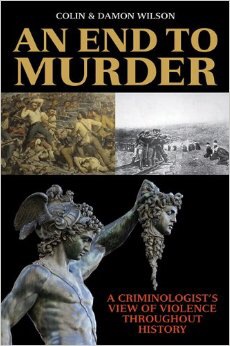
Meanwhile, the book that Colin was working on before his stroke has been completed by his son Damon. Entitled An End to Murder, it will be published this September by Robinson in the UK and Skyhorse in the US. This promises to be a very interesting title:
Creatively and intellectually there is no other species that has ever come close to equalling humanity’s achievements, but nor is any other species as suicidally prone to internecine conflict. We are the only species on the planet whose ingrained habit of conflict constitutes the chief threat to our own survival. Human history can be seen as a catalogue of cold-hearted murders, mindless blood-feuds, appalling massacres and devastating wars, but, with developments in forensic science and modern psychology, and with raised education levels throughout the world, might it soon be possible to reign in humanity’s homicidal habits? Falling violent crime statistics in every part of the world seem to indicate that something along those lines might indeed be happening.
Colin and Damon Wilson, who between them have been covering the field of criminology for over fifty years, offer an analysis of the overall spectrum of human violence. They consider whether human beings are in reality as cruel and violent as is generally believed and they explore the possibility that humankind is on the verge of a fundamental change: that we are about to become truly civilised.
As well as offering an overview of violence throughout our history – from the first hominids to the twenty-first century, touching on key moments of change and also indicating where things have not changed since the Stone Age – they explore the latest psychological, forensic and social attempts to understand and curb modern human violence.
To begin with, they examine questions such as: Were the first humans cannibalistic? Did the birth of civilisation also lead to the invention of war and slavery? Priests and kings brought social stability, but were they also the instigators of the first mass murders? Is it in fact wealth that is the ultimate weapon?
They look at slavery and ancient Roman sadism, but also the possibility that our own distaste for pain and cruelty is no more than a social construct. They show how the humanitarian ideas of the great religious innovators all too quickly became distorted by organised religious structures.
The book ranges widely, from fifteenth-century Baron Gilles de Rais, ‘Bluebeard’, the first known and possibly most prolific serial killer in history, to Victorian domestic murder and the invention of psychiatry and Sherlock Holmes and the invention of forensic science; from the fifteenth-century Taiping Rebellion in China, in which up to 36 million died to the First and Second World Wars and more recent genocides and instances of ‘ethnic cleansing’, and contemporary terrorism. They conclude by assessing the very real possibility that the internet and the greater freedom of information it has brought is leading, gradually, to a profoundly more civilised world than at any time in the past.

IMG_0511

IMG_0567

Colin Wilson Memorial, St. James Church Piccadilly, Oct. 14th

The impressive church in Piccadilly was a perfect location for a celebration of the life and works of Colin Wilson. For not only had Colin spoke there previously – on Superconsciousness – not only had it served as a memorial location for Robert Graves, St. James was also the scene of William Blake’s christening several centuries ago. As I gazed at the font which perhaps once held the infant who would later write about the cleansing of the doors of perception – lines read this afternoon by a very young relative of Colin’s – I ruminated on his theories regarding synchronicity and time perception. Thoughts that would clarify as the day wore on.
At 3pm, pianist Michael Servent plays Trois Mouvements Perpetuals by Francis Poulenc, after which the Revd. Lindsay Meader welcomes us all – Colin’s family, friends and scholars – with prayers. Master of Ceremonies Colin Stanley then went on to introduce several speakers, each representing a different facet of Wilson’s ‘Existential Jigsaw Puzzle’.
Gary Lachman was first up, delivering a compacted miniature of Wilsonian phenomenology. As Gary spoke about Wilson’s development of Husserl’s epoche, he demonstrated a move which Wilson himself performed at his own lectures – clenching his hand in front of his forehead to illustrate the tactility of perception. Hearing Wilson riffs such as Heidegger’s ‘forgetfulness of existence’ from the pulpit reminded me not to forget these insights, and therein lies the simple conundrum of Colin’s work. Gary will be publishing a full study of Wilson “in 2016” which is of course the sixtieth anniversary of the appearance of The Outsider (an international Colin Wilson conference will be held at Nottingham University to celebrate the anniversary).
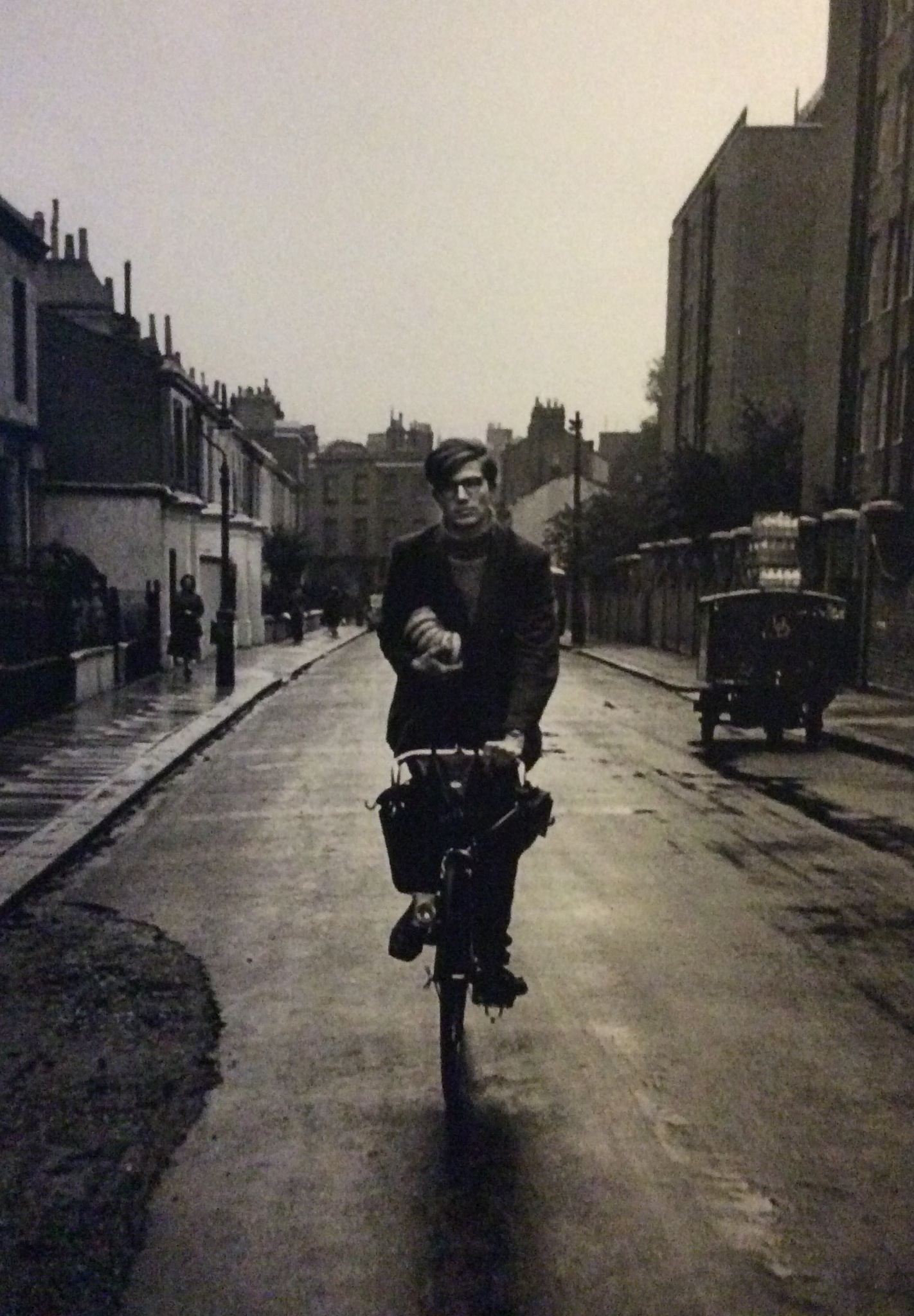
Laura del Rivo spoke next, painting a vivid portrait of Soho in the Fifties with some amusing anecdotes, such as Colin “showing three Finnish nurses around London.” Looking at the photograph on the memorial card also brought this era to life. The youthful philosopher cycles through a virtually empty London street – there’s one (?) pedestrian, possibly a ‘motor car’ and a milk float piled with crates. This is the environment in which you could find yourself a hostel before signing on at the labour exchange, and instantly get some manual labour while you worked on your novels. This world, unfortunately, has vanished forever.
A highlight of the service was undoubtedly the violin playing of Kerenza Peacock. Her rendition of Shostakovich’s Romance of the Gadfly, and later, Massenet’s Meditations from Thais, both with composer Howard Blake on piano, were emotionally charged reminders of Wilson’s lifelong love of “the brandy of the damned.”
Donald Rumbelow, criminologist and former policeman, led us through the backstreets of “Ripperology” – a term Wilson coined – and celebrated the intellectual angle of books such as Written in Blood, acknowledging the serious importance of the Encyclopaedia of Murder in the development of true crime writing. Later, Geraldine Beskin of The Atlantis Bookshop would inform us that her great-grandfather was arrested as a suspect in the hunt for Jack the Ripper. It was a day of meaningful coincidences, as Colin would have wanted.
A powerful reading from Ritual in the Dark was performed by Nicolas Tredell. Hearing Wilson’s words reverberate through a building with connections to Blake was a reminder of the necessity to clean our doors of perception. Afterwards, a small girl reads those very lines. You could imagine Blake beaming with delight.
Author of The Flying Cow and other Fortean classics, Guy Lyon Playfair, told us that The Occult was the most expensive book he’d ever bought – the postage to Brazil was enormous. Yet it remained his bedtime book and a classic companion to those who would walk with the Gods. It was pleasing to hear him speak about Poltergeist!, which is sometimes neglected when celebrating the paranormal corner of the oeuvre. As with Donald Rumbelow, the philosophical aspect of Wilson’s enquires into these apparently contradictory subjects was stressed.
It’s a testament to Wilson’s far-reaching capabilities that it should take several speakers and musicians to do his legacy justice. For although everyone who spoke (and most in the audience, in fact) knew Colin personally, it was up to one of his sons to sum up (after Colin’s Stanley’s speech about Wilson’s importance as a writer) his father’s life with the personal touch.
A recurring motif through the proceedings had been an image – a question mark. This was the signifier replacing a portrait of the mysterious Jack the Ripper in The Fifty Most Amazing Crimes of the Past Fifty Years. Colin Wilson would devour this sensational volume as an eight year old, despite being forbidden to do so, and the book would be mentioned several times throughout the memorial. When Colin’s son – and co-author – Damon gave his moving speech, pausing to be heard over the roadworks outside (drilling had interrupted Robert Graves memorial here too) this book would reappear in a typically spooky manner. Damon had spent all day clearing out Any Amount of Books in Charing Cross Road, and as the endless stock solely disappeared into his van, the room slowly became bare. His task eventually completed, Damon looked at the empty room only to spy the famous volume with the question mark portrait propping the door open.
Listening to one of Colin’s sons describe his fathers’ everyday work and life was illuminating. Some books made money, some didn’t, some were commented on, many were ignored, and the Wilson household was often overdrawn. But it didn’t seem to matter; Damon noted how much his father loved to write, loved his family and enjoyed the company of like minded individuals. He was a generous man, and most of us gathered at this memorial were lucky enough to enjoy some time with him, myself included.
After the Rev. Meader leads prayers and blessing, Michael Servent closes with Debussy’s Claire de Lune. The memorial over, we file downstairs for refreshments. And I, like most other attendees, promise myself to hold Wilson’s philosophy tight in my consciousness and never let go.

IMG_0451.JPG

Colin Wilson Conference 2016

To celebrate the 60th anniversary of The Outsider, Nottingham University will be hosting a Colin Wilson Conference with four speakers (to be confirmed) plus an exhibition of Wilson materials from their Manuscripts and Special Collections Department. Full details on how delegates can attend and who will be speaking will follow later but places are strictly limited to just 50. The cost per delegate will be £27.50 plus VAT. Free car parking, refreshments and lunch will be provided. Those who think they might like to attend should contact Colin Stanley although no final decision or money will be required from them until January 2016. This will be an important event and places are likely to go well before the anniversary date!

More vintage Wilson reissued

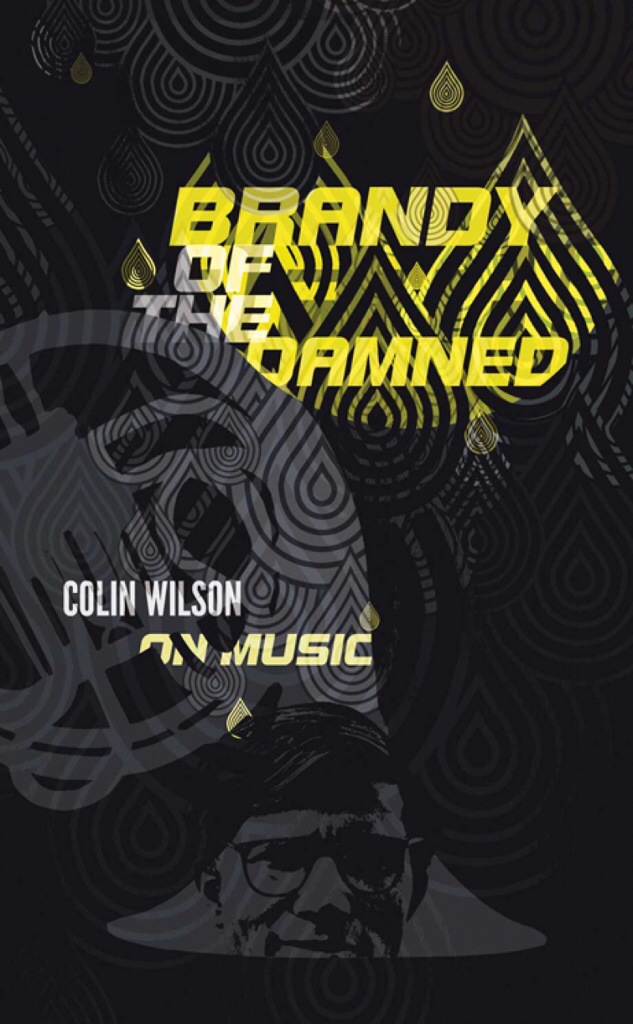
Wilson’s long out of print work on music, The Brandy of the Damned, has been reissued by Foruli Classics. “Dedicated to bringing the best music and popular culture books back into print.” I’m not sure if this is the shorter UK version or the expanded US version, but it incorporates some of the artwork from the UK version of the latter (confused?) which was published by Pan as Colin Wilson on Music. Phew! Meanwhile, Geoff Ward provides an introduction to a very welcome reissue of The Glass Cage. Published by Valancourt, it’s also available for Kindle.

20140802-113236-41556461.jpg

Colin Wilson Memorial Service

From Colin’s bibliographer and friend, Colin Stanley –

There is to be a Memorial Service for Colin at St James’s Church, 197 Piccadilly, London W1J 9LL at 3pm on Tuesday October 14, 2014.

Everyone is welcome and I look forward to meeting up with those of you who are able to attend.

CW in “the world’s most unusual magazine”

There’s an excellent (2007) interview with Colin Wilson at New Dawn magazine, available here. Choice quote – “As a thinker I place Edmund Husserl and his phenomenology at the centre of my approach, and I point out that it was because of certain simple logical errors that Sartre, Camus and Heidegger end as pessimists. When Husserl’s programme is carried out correctly, the outcome is positive, not negative. Derrida is a more recent example of a ‘Husserlian’ who failed to understand Husserl.”
There’s also a fine CW tribute by Frank DeMarco, and other interesting articles – well worth just over three quid!!

Colin Wilson’s Existential Literary Criticism – a review.

Colin Wilson’s Existential Literary Criticism [Colin Wilson Studies # 23] By Colin Stanley (Paupers’ Press, 2014)

The third in the ‘guide for students’ series on Colin Wilson’s work and the 23rd instalment in the Colin Wilson Studies series sees Wilson’s bibliographer turning his attention to one of Wilson’s best inventions – Existential Literary Criticism.
Existential Literary Criticism (ELC) is described by Wilson himself as a “different approach” to literature. After he published a tentative demonstration of ELC on the work of Aldous Huxley in a periodical in 1958, a reader complained to say that the only difference between criticism of the Existential and ordinary kind was the former’s pretentiousness. You proud Anglo philistines crack me up! Misunderstandings never change, it seems. So one year later Wilson wrote his important essay Existential Criticism which is now handily reproduced as an appendix to this volume.
It used to be annoying reading the opening sentence of that essay. Frustrating, because when I first read it, Deconstruction was the trendiest thing on the catwalk. Now that Derrida’s Politically Correct relativism is consigned to the landfill, like so much of last season’s high street fashion, it’s interesting to read it – “It is my hope that, within the next two decades, the techniques of existential thinking will become a commonplace in England and America. They would undoubtably provide a solution to many problems…” Needless to say, that hasn’t happened – the academy will always take the easy route. But ELC as a technique is a definite solution to still ongoing problems. “The disease of our time is the diffidence, the sense of personal insignificance, that feels the need to disguise itself as academic objectivity when it attempts to philosophise.” Fifty five years later and it’s still true. The garments have changed several times down the decades, but the deceit is still there. Contemporary writer/philosophers like Thomas Ligotti and Ray Brassier are still at it, like Japanese soldiers who don’t realise World War Two is over. Nihilism salesmen are an extreme example, and they do at least advertise their prejudices loudly enough to safely ignore them. Although their bland acceptance is of no actual use in studies of intentional consciousness, it does serve as an historical illustration of how much resistance – or rather, ignorance – there has been to Wilson’s bounty of ideas. The past fifty odd years of posh culture have generally ignored Wilson’s usefulness and have been mostly treading the same puddle in different togs.
So what does ELC have to do with this problem of ‘the fallacy of insignificance’? It mercilessly tracks a spotlight on any indulgence, any weak spot that confuses personal prejudices with objective perception. It is fundamentally a phenomenological technique, and it is relentless. There is no detail – however excruciating – spared when Wilson is in full flight (see, for instance, his The Misfits, 1988). ELC is not interested in style over content; David Lindsay is higher in the Wilson canon than many other technically proficient writers. It isn’t interested in reinforcing illusions of handed-down greatness; James Joyce is dissected as a self obsessive foghorn. It is only interested in meaning and values. In a much more dramatic and direct way, Wilson investigated criminals and murderers who would narcissistically lay their deceptive minds and life rejection on the autopsy slab for all it see. ELC is of course dealing with something more subtle and useful – literature – but Wilson’s method is essentially the same; to draw attention to the negative prejudices in documents that claim to be objective (in literature, his prime target is the I-am-a-camera type of novel).
For the rest of his career Wilson used this technique as a tool to extract intentions and meanings from an extraordinary number of texts, without any specific need to draw attention to the apparent difference between ‘high’ and ‘low’ culture – that obsession with ‘difference’ is slowly rotting academia away from the inside like a septic tooth. Jane Austen or Juan Butler, H.P. Lovecraft or Heidegger – they were all trying to say something. And that something is far more important that the styles they clothed it in. That is merely outward appearance, not the hardcore rigour of phenomenological analysis.
The inclusion of the (quite scarce) 1959 Wilson essay in this volume is the best place to start. Elsewhere, Colin Stanley gives the neophyte the meat of the ELC books, and for the obsessive, a list of even more books, pamphlets and articles to hunt out, all drawn from from his immense CW bibliography.
The books discussed in the main trunk of the text are some of Wilson’s most focused. The Strength to Dream, Eagle and Earwig, Poetry & Mysticism, The Craft of the Novel, The Bicameral Critic, Existentially Speaking, The Books In My Life, The Angry Years and Existential Criticism: selected book reviews are separated by quite large gaps of time and, after the first two, hidden in between large thickets of occult esoterica and criminal texts, amongst other things. Most are all still in fairly easy to find, save Eagle and Earwig (some of it’s content is in Existential Criticism, 2009) so the summary here is welcome. Colin Stanley has himself noted a dilemma in that, when writing about such a clear voice as Wilson’s, there is a danger in obscuring his essentially simple message. Wilson was aware of this when thinking about his own vast catalogue. What makes this book valuable to those not familiar with his work – apart from the summaries of the texts – are the quotations that are on nearly every page. For instance:
“…the novel – and to a lesser extent, the play – represented a new dimension in human freedom…it seemed there were no limits to the human imagination; using this vehicle of the novel, it could explore all time and space.” (Quoted from The Craft of the Novel).
Colin Stanley’s guide series is an extremely useful map for those daunted by the size of Wilson’s catalogue – which is still large when the best books have been cherry picked. Like Howard Dosser’s 1990 study Colin Wilson, the Man and his Mind, it is a necessary to understanding a big and fascinating territory. This particular volume brings notice to an often overlooked part of Wilson’s thought and for that alone it is welcomed.

Colin Wilson’s Existential Literary Criticism is available at Amazon or direct from the publishers.

CW poem by Eric Nicholson

Here is a tribute to Colin by Eric Nicholson. See how many Wilson references you can spot!

Book title autobiographical sketch with special reference to the titles and themes of

Colin Wilson.

Looking backward, how much of my life was

a ritual in the dark?

I cultivated the strength to dream but

neglected my deeper self. . .

First I lived as a semi-steppenwolf and sang

a song of stone; light and

death were my companions.

I remember midnight

on the desert ( of time and stars)

in those desolate years. (The outsider archetype,

plagued by traumas and fears.)

With my backpack bulging I set off in search

of the miraculous, convinced I was more than

a ghost in a machine.

So, I was dreaming to some purpose, fighting

the war against sleep. For many years

I toiled along the mountain path. The dark night

of the soul part of the scene.

I decided too early that the way

ahead was in doing nothing. Yet even the masters

say their lives consisted of one mistake

after another! Light goes with darkness as

the steps in walking. Walk on!

The lifeforce is impersonal and is all

and everything; a flickering flame dancing​

through the aeons. (See a billion bipeds scurrying like bugs:

that’s you and me as well as sages and thugs.)

The trembling flame flickers through

a billion flickering life-forms and seems –

ceaseless and eternal. A thousand names

for joy!​

(This is the universe’s purpose; to become

conscious of itself. . .)

I am not who I thought I was. . .

I talk of dreams but practice the power

of now; no longer fear

and trembling quite as much.

Adrift in Soho essay

Colin Stanley has an essay on Adrift in Soho at the London Fictions website. “Despite the ‘swinging sixties’, Wilson maintained this stance, against the use of drugs to induce higher states of consciousness, preferring more intellectually-based methods.”